|
The Surprise Invitation
to Perform, and the Performance During Baba's 70th
Birthday - Part - 2
Radio Sai (RS):
After 12 years of learning and evolving and taking baby
steps to understand yourself and Baba, building this
relationship… suddenly, you were catapulted into
limelight. You got to perform at the 70th birthday in
the Divine Presence. From this anonymity to the
celebrity status, how did this change occur?
 |
|
|
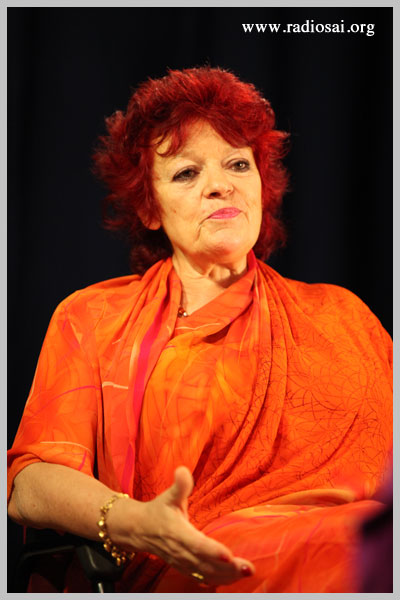
Ms. Dana
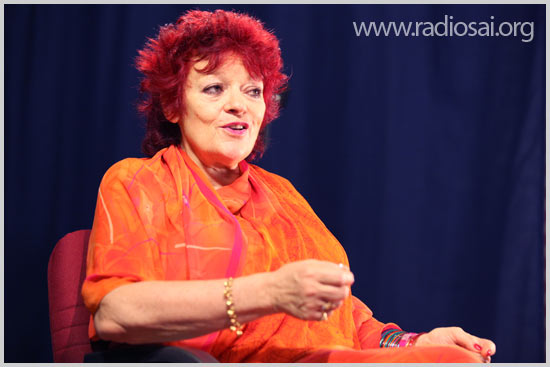
Gillespie in the studios of Radio Sai, March
2011 |
|
Dana
Gillespie (DG)::
Well, I thought it was going to
occur because I’d made my first bhajan CD.
There was this marvelous music and I thought the
Westerners must get to learn it, because in those days,
there was only those Bhajanavali cassettes. And if you
bought them in India, they were broken by the time you
played them once. It was before the days of CDs and I
thought, “If I can make this music a bit more acceptable
to the Western ear, I might be doing some good.”
So I put it on a
cassette and it was my last day.
And Swami had never
spoken to me. And I never spoke to anyone here. Nobody
knew I was a singer. I’m not really the sociable type. I
was just happy to be in His presence, albeit at the
back. So, I just managed to smuggle this cassette
in, which I’d hidden under my shirt. And as I said, I
told nobody. And He came straight over to me. It was my
very last darshan of that trip. And I’d wanted
to present it.
He
said, “Ah! The singer! Give me the cassette!”
And so, I had to produce
(from its hiding place) this hot and sweaty thing and
hand it to Him and He took it into the mandir. He’d
finally accepted this little offering.
So, I did go ahead and
press the first CD, which I made three under the name of
‘Third Man’. I didn’t want to confuse the blues fans who
might have mistaken it to be a new blues CD from Dana
Gillespie and put it on, “Oh! What’s this?” So, I had to
change my name. Then, of course, they started releasing
it here with a sticker saying “Featuring Dana
Gillespie”. Now I don’t bother with ‘Third Man’.
| |
 |
 |
 |
| |
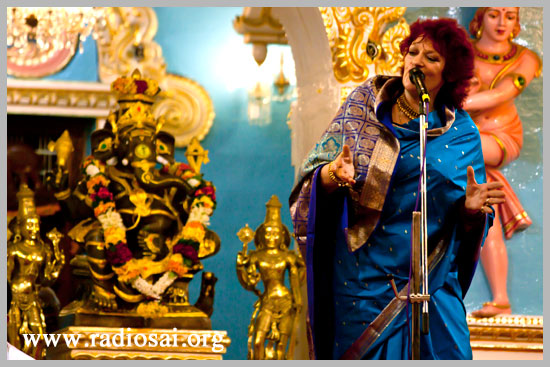
The many music
albums by Dana Gillespie through which she
expresses her love for Bhagawan
and spreads His message of Love. |
So when I get a call in
London saying, “Would you be interested to come and sing
for Swami’s 70th birthday?” from somebody connected with
Brindavan in Whitefield, I said, “Well, Yes!” and I was
convinced they wanted bhajans. I was imagining
me with my trancy, groovy rhythms… this is bound to be
the thing and I was told, “No no! Swami wants you to do
the Western music.”
So, I had to search
around for musicians that could actually help me out
because half of my band said, “We’re not going to go to
a place where you can’t eat meat, smoke a cigarette, or
have a drink.” That was quite difficult. But, I managed
to get an odd assortment of guys together and that was
my first experience. And it was an amazing one, because
when we arrived there was somebody meeting me at the
airport with the sign 'Artists'. The crowds parted. We
were looked after. Everywhere
I went, I was
being fed, couldn’t believe my luck.
RS:
You’d had a huge changeover in your life in Puttaparthi
now!
DG:
Yes, but it wasn’t always a bed of roses. I learnt some
interesting things. I got a terrible flu-like thing two
days before. I had no voice at all on the day of the
concert. I couldn’t see my band, since they were in the
men's section, I couldn’t tell them and I didn’t want to
worry them because they had no idea what they were
doing. They knew they were coming for some sort of weird
Indian experience but this was beyond their realms of
imagination. And also, you know, everything was chaotic.
And I learned a very good lesson.
The performance
which was about to go on before me, was axed at the very
last second. So, all these little children with mascara
trailing down their faces were really unhappy. Anyway, I
said to Swami (I’d learned to talk inside by this time)
and He was sitting in the Shanti Vedika:
“Listen, I’ve got no voice. You’ve got me all this way.
You’ve got to help me. If you’re going to help me, would
you please look at me now?” And He turns His head and
looks at me.
So then, two minutes
later, somebody came up to me and said, “I think you
should have these five cloves.” And then somebody else
came up to me and said, “Here’s some vibhuti
for you”. And I must say when I stepped out on stage to
sing, I probably had about 60 percent of voice but
that’s enough for blues. I had no idea what I was doing.
“Dear Lord, will You
swing while I sing?”
Everyone had said,
“Don’t worry. The day after the concert, all the artists
get an interview”, which, of course, when you don’t know
anything, that seems to be your goal — “I must get an
interview.” It took a while to realize that the inner
view was the better way to be. So, the next day, we’re
all lined up — the women, the artists, the men.
Swami comes out and He picks every single person except
me. I’m the only one that sat on my own for once in full
view of everyone, wanting to die.
RS:
That must’ve been so hard!
 |
|
|
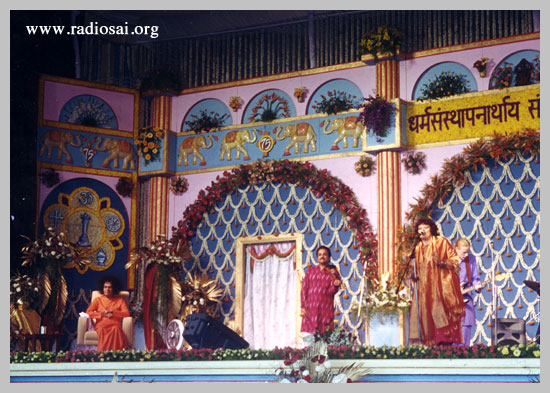
Ms. Gillespie
performing during Bhagawan's 75th Birthday, Sri
Sathya Sai Hill View Stadium. |
|
DG:
Well, it was. Even as I tell you this now, I can almost
taste the blood in my mouth where I chewed my gums so as
not to cry, because I basically just wanted to howl and
fall to pieces but I was in full view and I’m British.
So, you have to have the stiff upper lip. So, I chewed
my gums and I had to hold my head up high and walk out
of that place knowing that I was the only one who’d been
rejected. Awful! Awful feeling!
RS:
What was going through your head? Were you
self-introspecting or wondering what went wrong?
DG:
Well, I thought everyone hated me anyway for singing
blues. Don’t forget that at the moment that He’s
swinging on the jhoola, there’s blues going on.
And I know 99.9 percent of the Indians are expecting
marvelous holy music with sitar or something. So, I
thought they’re going to hate me.
And in fact, a day or two
later, a German woman said to me (didn’t know it was
me), “Ah! That dreadful Western music when He’s on the
jhoola!” And I said “Well, actually, it was
me!” And she went the color of a tomato but I understand
people’s reaction.
They’d never heard blues
because most people don’t know how spiritual blues
actually is and it is a thing that is very heartfelt.
So, He didn’t tell me, but I felt… yes, the nice thing
is He answered a prayer. And this is the other thing. If
you do pray to Him, He does answer your prayers. And we
forget this.
Well, about five
years earlier, at the Sai center that I went to, and
still go to, a man was talking about the significance of
Krishna playing the flute, the nine-holed instrument,
and when we are empty like the flute, then obviously the
Lord plays the best melody. And then, he said, “And the
reason you have the Lord swinging on a jhoola
is because He should be swinging in your heart.” And I
remember thinking, “I like that symbolic thing of the
Lord swinging in your heart.” And I just made a prayer,
“Dear Lord, will You swing while I sing?”
And five years later,
He’s on the jhoola.
RS:
And you’re singing to Him!
DG:
Yes, although I was probably still hated by 99.9 percent
of the audience. But, they’ve slowly kind of got used to
me. I mean, I’ve performed in the Poornachandra Hall
with backing tracks. That’s also rather an unusual
thing. I’ve never seen anyone with backing tracks.
RS:
But if I may backtrack, how did you make sense of that
moment where Swami didn’t pick you as an artist? How did
you convince and console yourself and come back? I’m
sure you felt terribly rejected and sad at that moment.
DG:
I felt small, lonely, and unloved. It’s quite difficult
for me to feel small. But, I certainly felt it then,
went home to my room and howled into my pillow. But
then, I remembered about this prayer (to sing when He
was on the swing). So, I knew that He’d answered it.
But of course, I was
still yearning to have an interview… but I went home and
it was still a great experience. I came back a few
months later and He did actually give me an interview.
He didn’t say very much to me, but I think He just knew
I was yearning to see what the inside of the room was
like, anything, I didn’t know what I wanted.
I’ve never known
what to ask Him because I don’t know what I want. He
knows! He did ask me once, “Any questions?” and as
usual, I can’t think terribly intelligent.
So, I just said to Him, you know, “What is the point of
it all? What’s this thing called life? What’s it all
about, basically?” And He just said, “Play the game, be
happy!”
RS:
Very significant words!
Traveling to the Corners
of the Globe as an Ambassador of Sai's Love
DG:
But so many people forget it. And I travel all over the
world as you know, singing at Sai centers and places
that most people don’t know where they are. And I always
tell this to people because when you’ve got terrible
times and things are hard, and all of us have tough
lives, I mean, nobody escapes without pain and,
unhappiness or death or illness - absolutely nobody. We
have to remember that it’s He that pulls the string. In
a way, we’re like puppets. This is very difficult for
the West to accept. They consider surrender a sign of
weakness. Well, about 10-12 years ago, I started getting
calls and people would say, “Can you come and sing
here?” If I’m not there with my blues band and I’m
actually free, I’d say, “Yeah, okay, why not?”
RS:
So, you’ve flown to countries people haven’t heard of?
DG:
Well, have you heard of
Dagestan?… though it’s not technically a country. It’s a
part of Russia. But it’s on the Caspian Sea, next to
Azerbaijan.
Also, Uzbekistan,
Kazakhstan, Kyrgyzstan, Siberia, Lithuania, Latvia,
Estonia, Romania, Hungary, Poland, as well as the well
known destinations like Australia and America. But, I
love these countries that are Muslim. They’re
Russian-speaking, but the Muslim countries I adore. And
Swami once said to me… He was talking to somebody else.
He suddenly looked to me and said, “The Sufis are very
good.” And then He carried on talking.
And this got me thinking
because I’ve always liked the aspect of Sufi thought.
You know, it’s not a religion. It’s not organized. Its
religion is the religion of love. And there’s no
intermediary like a priest. You need somebody to speak
to God? No way, it's ridiculous! Let me go direct to the
big boss, which of course as we know is inside. And the
Sufis function like that.
And I was quite cheered
that He should say this and I’ve had quite a few
interviews when I was surrounded by Iranian Muslims when
I’ve been in there, which were quite rare in the old
days. There were not so many of them. I’m happy to see
there are a lot more now. So, I have a feeling that’s
why He’s always made sure that I’ve enjoyed these
bhajans like ‘Allah ho Akbar’ and ‘Salam alaikum’.
It’s a very old bhajan over 50 years old.
RS:
And when you go to these countries which are former
republics of the USSR, with a majority Muslim
population, how do people react to your music and to the
message of Sai that you take to them?
DG:
They adore it, they absolutely adore it. I think they’re
quite happy that anyone is mad enough to go to these
places. I mean, because some of them are villages in the
middle of nowhere. I’ve slept practically on floors and
it’s not just me alone. It’s with the heads of Zone 8.
RS:
Russian-speaking countries of the International Sai
Organization?
DG:
Yeah. And one of them is a Dane - Steve Picolo. And one
of them is Valerie, the Russian. I’m not sort of thrust
into the world on my own. I’ve got a little bit of a
team around me. And they react amazingly. And because
I’m not shy or timid or nervous in front of a camera or
a microphone, because it’s what I’ve been doing, for me,
it’s like breathing, I make people feel at ease when I
talk to them or sing to them. And I think people can
react to this. Even when I sing in front of Swami, I
talk how I’m talking to you now because that is
communication and it’s from the heart.
 |
|
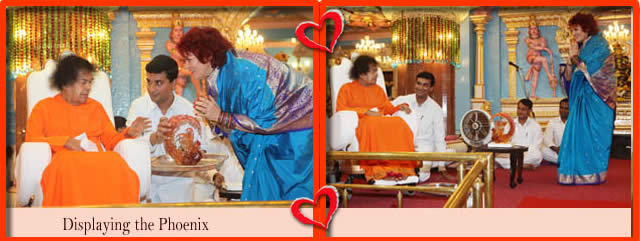
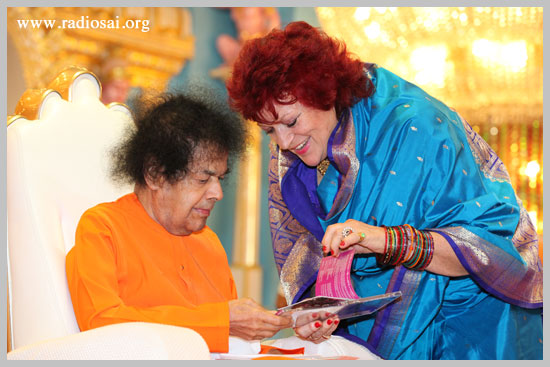
Ms. Gillespie
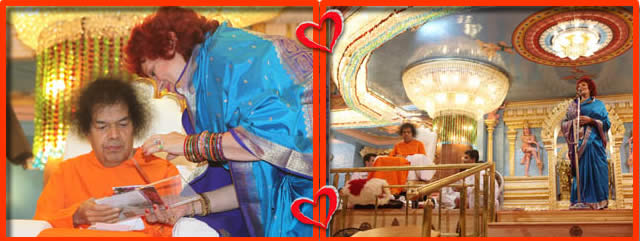
presenting Bhagawan with one of her albums
before her performance
in the divine Presence, December 2010 |
|
So, they react to this
and I have a chance later on stage, I tell them the
words of the songs that I’m singing. So if it’s a
bhajan, obviously, they usually know them better
than I do.
People of these countries
are so starved of religion, they having been depressed,
compressed, pressed down.
RS:
Repressed with communism all these years, Godlessness.
DG:
All these years of Godlessness… now they are
flourishing, blooming like flowers and absolutely ready
to imbibe it. And the amazing seva that they do to
homeless people, to animals... Swami has said the
Russian-speaking people have an amazing heart and it is
very similar to Indian hearts. And they react amazingly.
So, of course, from the moment I start off with ‘Allah
ho Akbar’, they’re beaming away and little old Muslim
men with orange beards and a stick and a hat popping up
and down, which is unheard of.
And sometimes, they get
up and dance to the bhajans which of course I’m
quite pleased about. I always say this. It used to make
me miserable, but the first bhajans I ever
learned of these Bhajanavali cassettes, came with one
bhajan book - it had a list of rules at the
beginning saying ‘Things to do and not to do’ when
you’re singing bhajans. And one of them is that
you must sit rock-still. This used to bother me as once
the music’s going, I can’t sit still. And Swami once
said, “Yeah, Dana, she dances like this.” And He did me
better than I do me.
What a sense of humor He
has! So, He knows I’m not going to sit still and I know
probably it (my swaying to the beat) wasn’t very popular
in the beginning.
Well,
bhajans in the early days were for people who
knew about Swami. But my job is to take His message to
people who don’t know about Swami.
And not everyone can get the hang of bhajans.
So, I’ve made them slightly groovier for your man in the
street… A lot of Indians in America, this is about 15
years ago, would come up to me and say, “We love your
‘Third Man’ albums because our kids who don’t like
bhajans are now listening to it because there’s a
beat.”
But I was worried in the
early days as I did a version of ‘Prasanna Ho’ with a
disco beat and I performed it in the Poornachandra Hall
and I was thinking, “Oh, Swami’s going to be furious
that I’ve taken some holy music and put this beat.”
And not only was He not
furious, at the back of the Poornachandra, some people,
were up and were dancing in the Poornachandra Hall. I
thought that was pretty amazing. So now, in the
Russian-speaking countries, I tell them this story that
people have danced to bhajans and they all go
“Yes!” and they’re all up and dancing. So, I do it
usually as the last number and they’re all going
“Prasanna Ho!” and they’re all raving around like this
because music has to be joyous and it has to uplift the
soul.
RS:
And it’s a celebration of divinity!
DG:
Yes, absolutely!
Swami is Already There
RS:
When you go to these
countries, how do you introduce Baba to those people?
What do you tell them? Have you had any experiences
telling people or showing His picture? How do you go
about it?
DG:
Well, I do two different types of concerts. I will do
concerts or talks at Sai centers. So, I don’t have to
introduce Him. He’s already known. But somewhere like
Uzbekistan and Tashkent, it’s not technically allowed.
And Singapore too, you can do an insider’s concert; so,
that’s no problem; don’t mention Him. So I just mention
His message of love and for me the message is more
important. He Himself keeps saying that. So, it’s very
easy for me to talk about His message to these people.
RS:
Has anyone heard of Him before?
DG:
Sometimes they have. One
example was in Samarkand, we’d gone there with a team of
people.
That’s in Uzbekistan. And
I think this was where… I think it was Stein Picolo who
pulled out a photograph and showed to a little Muslim
woman and she said “He’s God! We’ve been waiting for
Him” and tears poured down her cheek. And then, an
11-year-old boy came and said “But I was playing
football with Him in the street yesterday.”
Then, we were in Dagestan
again with the same merry troupe and we’d heard that
there was a Sufi guy living in a far-off village,
basically with a few huts around him. And so, we take up
lots of fruit and things as gifts, drinks -
non-alcoholic obviously, and he’s in the middle of
nowhere, with no television or anything with him. And we
were sitting, waiting for him, because he’s got to come
back from the mosque as it’s Ramadan. We were waiting
for sunset. And again, Stein or Valarie says, you know,
“Have you heard of Sai Baba?” and he goes, “Have
I heard of Him?!”
He produces a
picture himself from his pocket. He’s got Sai Baba key
ring, and he said, “But He’s been here”.
And the Sufi gentleman brings us into his kind of prayer
room, if you could call it, and there’s a big picture of
Shirdi Sai Baba and Sathya Sai Baba on the wall, which
for a Muslim, who won’t have a form, is a pretty big
deal.
RS:
And Swami has been there physically for him.
DG:
Yeah, physically, yes, he’s seen Him.
RS:
And carried him gifts
with a picture and a keychain?
DG:
These things are
inexplicable for me. But they’re as inexplicable as… the
vibhuti pouring off pictures in various parts of the
world or the amrit dropping off things. I know these
things aren’t in the big picture that important. But if
you are living in a village somewhere in the middle of
nowhere and suddenly, I’ve seen this in a man in
Dagestan, Vibhuti appears on His photograph. I mean, the
joy that it gives is incredible, this omniscience thing
is incredible and I actually am more moved by devotees
who have never seen Swami in the flesh than those that
come here and see Him. And those that see Him in the
flesh can easily be misled and think that He is this in
the flesh.
It’s a very easy
mistake to fall into, you know, everyone’s wanting to
get up the front because they think “Is He going to see
me, look at me?”
It’s
so easy to fall into that trap. But over there, they
don’t have this possibility. So, they’re seeing with
inner vision.
In July this year
(2010), I was
in Russia, with Valerie in St. Petersburg and they’re
doing seva; they’re doing up the houses of
little old ladies who are of 80. One had only one leg.
They’ve got no windows, they’re broken, holes in the
ground or the floor, who’s going to cut their wood at
winter time? And it’ll be -30 degrees at winter time.
These people, their selfless service is amazing, they
were giving out food packets. I’m humbled to the size of
an atom when I see what these Russians do and I’m so
grateful that I’ve been given the chance to do this and
to bring some joy. And so, I was giving a concert
wherever I go.
And I never have enough
CDs, I can’t physically carry enough, you know.
RS:
There’s such a demand.
DG:
Yeah. And I just get on stage and I say, “Listen, make
copies. Bootleg, pirate, do it.”
RS:
No copyright!
DG:
No, no, because I think for bhajans,
it’s Swami’s music. It should be global. I long for
somebody to come into my life and go, “Let me handle
your whole stock of CDs and I’ll do a catalog” because
I’m not a businesswoman. I’m a musician and I can’t find
anyone that knows how to do it or has had enough oomph
to come to me and say, “I can do it.” But, one day,
He’ll send the right person.
I can carry in my bag
maybe a 100 pieces and then you’ve got over the limit of
your luggage. I must carry the right clothes for looking
presentable, because one is actually representing the
Lord and bringing good news.
| |
 |
| |
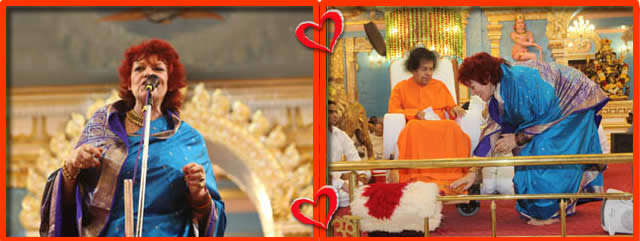
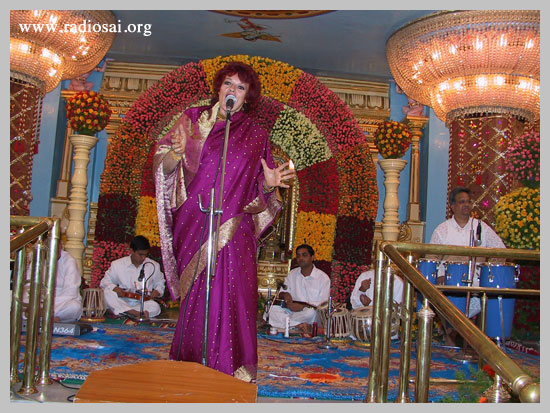
Since her first
performance at the time of Baba's 70th Birthday,
Ms. Gillespie was blessed
to perform during many following Birthday
Celebrations. |
RS:
Swami seems to have put you in this role where you’re
going to these Muslim countries in the former republics
of the USSR because you have a very strong Sufi
connection from a long time ago. Even your book ‘Mirrors
of Love’ has beautiful sayings from various faiths which
actually resonates what Swami says. And a lot of the
content is Sufi. Where did that connection start?
DG:
Well, I suppose I found
it more logical for me that all is one.
RS:
But Dana you’re a Church-of-England girl.
DG:
I was born but I always felt uncomfortable with that. I
actually never… really like the sign of the cross,
because for me, it represents pain and suffering. Every
English church has Jesus, with blood dripping off Him,
looking agonized. And over here, everything is joyous
and lovely.
And
as a child, I used to really be unhappy being told by
the priest, “Only through Jesus you’re going to find
salvation. The rest of you are going to hell and
damnation.” This as a child
I could not accept. And so, after I was confirmed,
which, I must tell you, I only did because my mother
paid me 30 pounds to go through this ritual. And I did
it for the money because I could have some more drum
lessons. I’m being honest with you now over this.
But, I always felt
uncomfortable with what I felt were lies. But the moment
I started to read any of the Sufi writers, if you read
Al-Ghazali, Ibn Arabi, there, love is so completely
all-enveloping.
RS:
Very strong Bhakti element there, huge focus on
devotion.
DG:
Absolutely! And it’s not
with any rituals. You don’t need a ritual. There are
some great saints in the Sufi tradition who were doing
things that Jesus was doing. But because the Church of
England, back in England, probably didn’t bother to read
about them, they thought that He was the only one. This
was how it affected me. I’m happy if everyone else feels
how they feel. Everyone should be free to choose
whatever form they want. But I didn’t feel comfortable,
because as you said, I probably was in a past life
strongly connected…
RS:
A very old soul connected with Sufism.
DG:
I think so. I probably
lived in a desert. I can’t even eat a date now without
feeling a bit nauseous. I probably lived on dates. And
I’ve got this passion for camels.
Part - 3
A COLOURFUL AND COSMIC CONNECTION WITH SWAMI
- Conversation with Dana Gillespie, British
singer, actress and song writer
RS:
Dana, you’re a huge fan of India as well, much like Max Mueller who said, “What
India cannot teach me, I do not need to learn.”
DG:
Yeah, I endorse that entirely. Actually now, I have to spread it a bit further,
because now the whole world teaches me that. Again, it must be a reincarnation
thing. I remember as a child of about five or six, my parents used to take me to
watch polo at the Royal Windsor Grounds outside of London. And most little girls
would be interested in the horses. I was probably interested that I was going to
get an ice-cream. But the main thing was that the Maharaja and Maharani of
Jaipur would always be there.
RS:
Oh, Gayatri Devi?
DG:
Yes, in their full gear. And I remember always
just going “Lord!” and looking, yearning and being fascinated by them, their
clothing. And then, in the early ’60s, in ’63, because I was seeing a lot of the
early musicians, like Jimmy Page of Led Zeppelin, and we’d go to concerts with
Ravi Shankar, Ustad Vilayat Khan, anybody, anything to hear Indian music.
I’d
been to India once before I’d been to Swami. So, I was already in love with the
country. The moment my feet touched Indian soil, I knew I had come home. And you
know for me, glorious Bharath is exactly that, glorious.
Swami once was asked, “Why is it that the Vedas are sung here? Why are only the
great leaders, spiritual leaders, born in India?” and He had said, “Because only
in India do they know how to live the message of the Vedas.” I mean, you’re not
going to find some sort of saint being born in the outer suburb area of London
or in Detroit. It just doesn’t happen. It’s because this country is so special.
RS:
Very sacred!
DG:
Yeah!
RS:
It’s very interesting, you said, as a little
girl, you used to watch the Maharaja and Maharani of Jaipur. I think perhaps
somewhere there in that little girl’s heart, there was an admiration for the
regalia they wore, because in later years, Swami has decorated you with a lot of
gifts which have a very strong Rajasthani flavor.
DG:
Maybe. I love color. Nothing is more boring. I
don’t do grey, for example. You haven’t seen me in any. Or browns. Because it’s
not my way. I love splashes of color. I’ve always been colorful when I came
here. He did once give me eight beautiful sarees in a week.
RS:
Prior to the sarees, you used to perform wearing
your Western clothes and a dupatta?
Tell
us about that.
DG:
Well, He often would come backstage, just to see
that the dupatta was pinned properly because you know, with all my movements,
you can’t have this thing flying off, everything had to be and it still is
covered. And rightly so, actually. But you know, I didn’t know what I was doing.
I was quite capable of rushing out and forgetting that I should put a dupatta
on, because I always feel in my soul that I’m a bit like a Labrador puppy that
wags its tail, knocks things over, and is happy to talk to and see everyone.
There’s nobody that I
don’t love because I love everyone, everything, even if people don’t like me, I
love them. So, that’s alright. So, it’s just this kind of happy state, I’ve
always been a bit like that.
RS:
And then came the sarees, all of a sudden - switch to sarees?
DG:
Yes, I did. Well yeah, I was called… to that little room at the side by the old
kitchen, not His interview room and there He gave me a stack of sarees. But one
of them was the one I wore for the 80th birthday. It was about 5 years before
this. He gave me this thing that weighs a tonnage. It’s heavenly — rainbows and
gold. He put it into my hand and it was so heavy I dropped it. And our Lord was
down on the floor, picked it up faster than I could get down and I move pretty
fast. And I knew as He gave it to me that I should wear it for the 80th
birthday. I just knew it. Sometimes, you know things.
RS:
Intuitive knowing, it’s very clear.
DG:
And I’m grateful when He gives me that because
every time I thought I’ve known it, I’ve made some terrible blunder. But when I
really take time to listen inside and I know it’s Him, then you can’t make a
mistake. And it’s our duty as humans to tune our inner radio channel to the
radio receiver, you could say, to the best channel, because when we’re in tune
with Him, we then get the best programs back. It just makes sense.
RS:
Very true! It does.
The
experience of performing with His Students
RS:
You have performed with some of the finest musicians around the world, but I
understand Baba gave you an opportunity to perform with musicians from glorious
Bharath, our local crop of musicians?
DG:
Oh yeah, Prashanti boys.
RS:
How was that experience?
| |
 |
| |
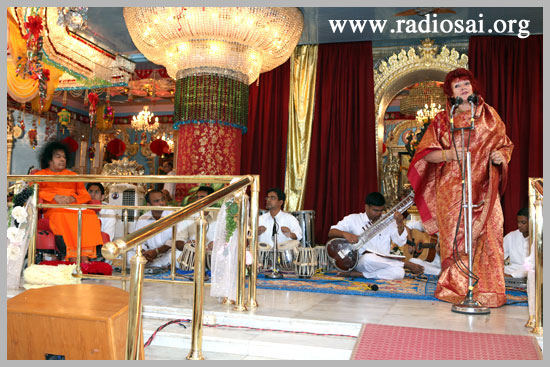
Performing in
the Divine Presence, April 2009 |
DG:
Fabulous. It was great. The first time was about nine years ago. And in fact, I
was about to arrive with my own musicians and two days before with my ‘Mirrors
of Love’ album.
And this was kind of Indian feel but sung in English. And my
musicians said, “Oh, we’ve heard there’s an outbreak of plague. We’re not coming
to India. Here’s your tickets back.” And I was totally stunned. So, I arrive and
no musicians. But I knew I was meant to perform. Somehow I knew. And Swami comes
straight over to me and says,
“Well, where are your musicians?”
I said “Swami, I haven’t got any with me.” He said, “I will send boys.”
RS:
Hmmm!
DG:
So, boys were sent. The house where I stay, there’s a room at the back. And we
started practicing there. And I had about six-seven boys and they had never
played that style before. And everyone worked a whole lot better and I said,
“You know, on stage, I’ll introduce you all by name.” And they went “No no no,
we can’t. We’re Swami’s boys. No names, please.” And Swami came and sat in the
room at the rehearsal. And the first thing He said, “You introduce each one by
name.”
We
used to perform in the Poornachandra Hall as well when it was empty. And I’d be
sort of sitting facing them and they’d all be facing the curtain, as they were
wise to the fact that Swami might have turned up. I didn’t know about that. And
they’ll be playing away and suddenly all the music would just sort of peter out
and stop and I’ll turn around and He’d be peeping through a crack in the
curtain, sometimes He’d be peeping down there, sometimes just a little bit of
hair would come through and then, they just sort of stopped. So, this was great
experience.
One
day, He said, “Don’t tell anyone, but I’m coming to the house on Thursday. Be
ready.” And I said, “But, can I tell the boys?” “Yes, you tell the boys.”
So,
the boys were told. And I had to tell the house because things were prepared,
everything was polished, clean, and the silver was brought out and there was a
table, laid out with, you know, about 15 plates of savory stuff and 15 joyous
bowls of payasam, which I’m mad about.
And
I’d been worried about how they were going to learn this in time, because this
was absolutely not the style of music that they did. And in fact, Sai Prakash
was on sitar and this was early days of his playing the sitar. He’d only been
playing for two years. Swami used to make him play before the bhajans
in the afternoon. And I’d been saying to the lady of the house where I stayed, I
said, “You know, I do not know how this sitar player’s going to do. I mean, he’s
really not on the board. It’s never going to work.” And this used to bother
because the other instruments were somehow merging in.
 |
|
Sai Prakash, a
student of Baba who has accompanied Dana Gillespie on many
of her performances in Puttaparthi. |
|
On
the day when Swami came, one could feel His presence as He was coming in. We
were just doing our songs and He walked in the door and as usual, everyone stops
playing and there He is.
And
He sits in the chair and the first thing He says to me is, “What do you think of
this boy?” And of course, it was Sai Prakash. And I was thinking, “My God! What
am I going to say?”
So I
said, “Well, Swami, he’s really trying very hard. He’s practicing very hard” was
all I could say. But I actually thought He’s going to be pretty out of tune on
the day and I hoped nobody could hear him.
And
then, we played the songs and He made comments. And actually after the
performance of doing the ‘Mirrors of Love’, He actually said to me “Divine
words” and that’s because I’d taken the words of the Sufis and put them to
music. Anyway, after the practice, we all go into the outer room and there’s all
the food laid out and Swami’s handing out the savory plates and I’m standing
right behind Him and I’m thinking, “Oh, I don’t want any of those savory stuff.
Cut that. I’d just love a bowl of that payasam!”
He
just goes straight there, gives a little stir, smile, hands it to me and then
goes back to the savory stuff.
So,
you have to be careful what you think because you may get it. In this case, I
was happy to get it.
Then, there was a row of chairs and Swami was sitting down.
Suddenly, Sai Prakash, (the student playing sitar) went into the other room and
came back with a little silver pot of cloves. And He looked up at Swami with
such love in his face that it really stunned me.
I have read and I know somebody had said that if you really want to see Sai
Baba, you look at the love in everyone else’s face and there you can see the
Lord.
And
I looked in Sai Prakash’s face and I remember thinking at that time,
“This look is so amazing! I don’t care if He
hasn’t even got any strings on his sitar, it’s worth it for that look alone.”
Actually, he was fabulous on the night and everyone played perfectly well.
But
I learn in all these little signs, I feel as if God is taking me step by step to
learn from little things, really, small things.
RS:
And how important love is! It overcomes everything in the end, including musical
imperfection.
DG:
Yeah, but he landed up perfectly. But, this was a
great experience. So, I’ve had the boys come and play with me for I think about
six times.
The
first time, they were very kind of… slightly stiff and uncomfortable. And I said
“For goodness sake, musicians must look happy.” I even said it last year —
“Whatever you do, boys, don’t sit there like blocks of stones. Look happy!
Because nothing is more depressing for an audience to look at people who aren’t
joyous with what they are doing.”
RS:
I’m sure it was a great learning experience for them to work with you.
DG:
Yeah, and for me to work with them too,
especially at the 80th birthday. I’d told everyone, “Please put up a tent over
the place where the musicians play” and they all said, “No no, it’s not going to
rain.” I said, “I know it’s going to rain.” So, they put a shamiana on,
but only for people who played were sitting down and I stood out in the rain,
got rained on, and they sat under the cover.
 |
|
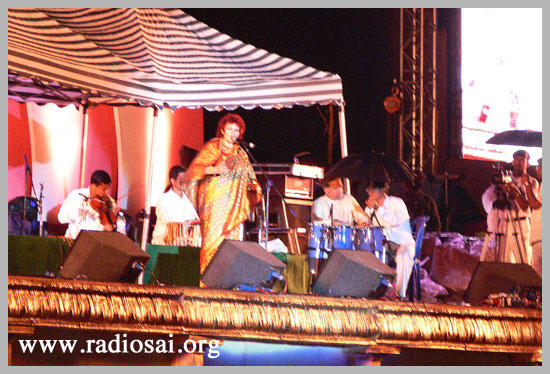
Dana Gillespie
performing at the Sri Sathya Sai Hill View Stadium during
Bhagawan's 80th Birthday Celebrations |
|
But
these boys… I’ve been honored to work with them - the dedication, the staying up
late at nights - they’re working on their drama thing and they’re working on a
load of other things. I learn from them too. It’s a joy, it’s an honour.
Her
Music was Her Service to the Society
RS:
Dana, you are so passionate about Swami and His teachings and your love, it just
comes through in everything you say. And yet, for some of us, it’s very hard to
make sense of the fact that you perform your music in places which are quite
dark.
DG:
Extremely dark!
RS:
And where people are not generally contemplating
upon God — in a club or a pub where you’re performing. How do you reconcile the
two?
DG:
Well, because I love everyone. I adore them. You
know, I’m singing in places where, let’s face it, half of the audience might be
completely drunk and a lot of them might be smoking cigarettes. But if you’re
sorry for people that don’t have the joy of knowing about Him, the least I can
do is uplift them a bit with blues music and if they’ve come out of that saying,
“God! That was a really great evening!” even if they’ve had a few beers, then,
job done as far as I’m concerned.
And I’ve always liked Swami’s description about in the morning,
when the sun rises over the water lily pond, not every flower is out. This is
how I see the audience.
And
they are as loved by Swami as anyone else. Once somebody said to Swami, “Ah! so
and so person, he’s very close to You.”
Swami said, “No no. Nobody is more close to Me than anyone else is close to Me.
Everything is equal.” And this is how we have to be, non-judgmental. You know,
I’m a little funny with alcohol because I hate alcohol personally and I’ve
always hated it even as a child. That’s the old Muslim of me coming out. So, I
don’t quite know drunkards are going to react. I’m a bit nervous. But, if
they’re enjoying the music, then, I’m giving them some pleasure.
So,
I’ve sung in appalling places, but blues music is good music and it’s honest
music and it’s spiritual music. So, if one man in there goes home and thinks,
“I’ve had a great evening”, even if he’s not thinking of God, one day, he will
and one day, his lotus blossom heart will be opened. So, I’m just entertaining
him till he’s ready.
RS:
When you’re performing, in your heart, are you thinking of Swami while doing it?
DG:
Often, yes. Well, if I think that maybe it’s
going to be a difficult audience, or it’s going to be… maybe it’s a huge outdoor
beer festival, sometimes we have to do these things, because my musicians have
to eat, we all have to earn our living and I think it might be tricky.
What I usually do is I imagine Swami’s hair
like a big umbrella over the crowd so there’s sort of a black cloud. So, it
always goes better. My musicians aren’t devotees. But, I sing songs… a
lot of the blues, it’s a bit like a ghazal. If you’re young, you can think it’s
physical love you’re singing about. If you’re older, you realize it’s divine
love. And blues is exactly the same.
 |
 |
 |
 |
 |
 |
 |
 |
|
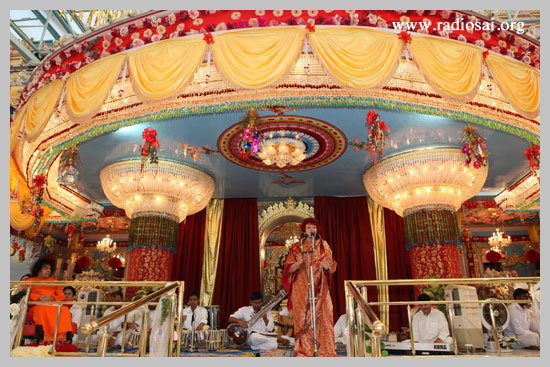
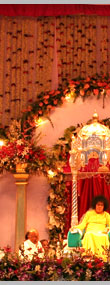
80th Birthday Celebrations - Bhagawan seated on the dais at the Shanthi
Vedika in the Hill View Stadium. The artists performed on a stage
specially erected in the eastern side of the stadium. |
RS:
Very in your face, yes.
DG:
Yes. Absolutely! So, they might think I’m singing
about… it’s like I said that song I sang “Your love is true” a few days ago.
RS:
The other day in Bhagawan’s presence.
DG:
They’re all thinking I’m singing about some mere
mortals, I guess. But I know who I’m singing about and I know who I’m writing
about when I write. So, sometimes if I can get a line in like in “I sigh for
you, I can get if I take one step to you, take 10 steps to me”, well, every
devotee’s gonna know who I’m singing about, which is what I did in Singapore.
There were devotees dotted around this audience. So, they know lines like “Why
fear when I am here?” or “Love all serve all” might be slipped into a song or “Soham”,
they would think I’m probably singing a word they’ve never heard of. It doesn’t
matter. So, I have a good time and I know what’s in my heart.
RS:
And when you sit to compose your music and write
your songs, it’s always God you have in mind, Swami?
DG:
I suppose it is but I don’t think of it as
clinically as that. Sometimes, a melody might appear from… could be from a car
horn or a cat meowing. Suddenly, I get an idea or I might hear a beat. Usually,
I write when I’m in Italy. I spend a lot of time there, when I’m not in London.
In London, my house is too full of telephones, there’s a television there,
there’s electrical wiring. And it’s a very small house. Swami once said to me,
“You live in a tiny little house”, He said, almost like that.
But,
I’m aware that London is masses of static energy and I don’t write well. I go to
Italy and I’ve got 180 degrees of sky and it’s peaceful. You get a germ of an
idea and then you work around it. And I’m often thinking of… I don’t really
think of it as God. It’s just a idea people might feel good listening to.
RS:
Positive.
| |
 |
| |
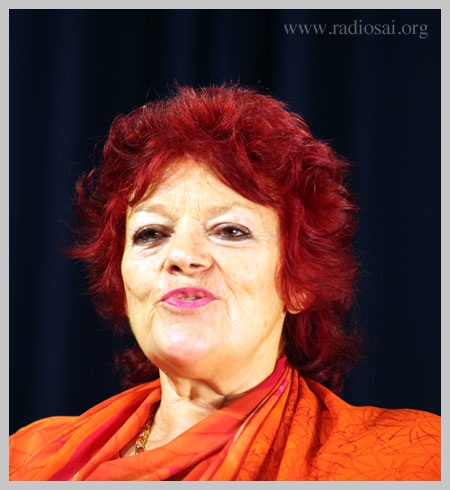
Ms. Dana
Gillespie in the studios of Radio Sai, March 2011 |
DG:
Positive, yes. Mostly I sing ‘up’ subjects
and I just want people to feel good. That’s my duty on the planet and it should
be everyone’s duty, you know, to make everyone else feel good.
But
I had a mother who instilled these amazing things. My mother was full of wisdom,
always saying pithy sayings like “Blessed is He that expecteth nothing, for He
shall not be disappointed”, stuff from the Bible. She used to drive the car,
taking me to school, singing hymns at the top of her voice.
RS:
Hmm! And your mother did accompany you to see Sai
Baba?
DG:
Well, when I came back the first time, nearly 30
years ago, full of enthusiasm, I thought everybody…
RS:
In the world should know about this.
DG:
The good news! He’s here, you know, I must tell
you about it. They said “You’re out of your head.” The only ones that believed
me were my parents.
They
said “We know you and if you’ve seen something, we believe you.” My parents had
remarried. So I had two sets of parents, they were both great. My stepfather’s
fantastic. My mother said… he wanted to go. So, I accompanied them. Within the
first year, I came three times — once alone, with my father’s wife, and then my
mother and stepfather.
My
mother came after her husband's passing; he was 10 years older than her. She was
in tears a lot. And Swami didn’t talk to her - I think she was too fragile
emotionally. And I’ve noticed too that He wants us strong and He makes us strong
from far off, sometimes. So, the second year after my stepfather died, my mother
was stronger.
But
then, we were called in and we had quite a few interviews together, and I often
would sit very close so that I could interpret, because sometimes my mother
wouldn’t know what ‘Abhishek’ meant or things like that. And she had quite bad
arthritis which you know of course I had gotten and He stroked her hand.
 |
|
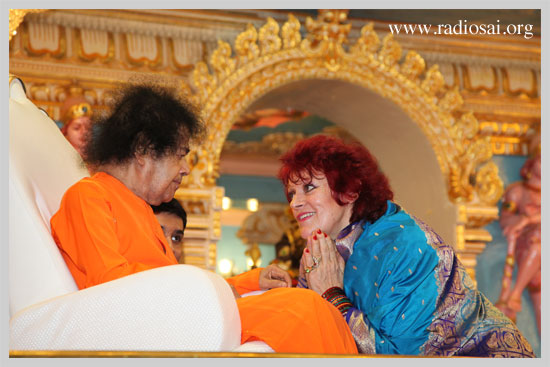
| With Bhagawan
after her performance, December 2010 |
|
I
went, “Swami, I’ve got it too.” And He’d gently push my hand away and go, “I’m
dealing with your mother now.” I mean, He’s got such a way. But He wants us to
be happy. And my mother was happy at the end.
He
said to her, “What’s your religion?” and she was quite surprised by this
question. She said, “Church of England”. He immediately gave her an amazing
crucifix. He was great with her.
"I
don’t know what He is."
RS:
You’ve known Swami for 30 years. You’ve performed
for Him. You’ve integrated Him in your life, which for many, is very divergent
from a spiritual path, because you’re in a business that involves glamour and
money and entertainment. At the end of it all, how do you relate to Bhagwan Sri
Sathya Sai Baba ?
DG:
The more I come here or the more I think about
him when I’m traveling or at home, I realize that I know absolutely nothing. I
mean, I can talk till I’m blue in the face but I know nothing about Him.
And I now know that the
emptier I am of having no desires and not wanting anything is by far the best
way to be. I just have to try and hope that the things I do are the right things
and that they are guided by Him. I don’t really
want to mess up any more than I have done in my past. But we all learn probably
the worst mistakes are our best learning curve.
I
don’t know what He is. You know, many people who come here all say they feel His
presence so much more when they go back home. I’m talking about the Westerners
and probably a lot of Indians. And I think this is a good thing, because we have
to realize the body is so unimportant, His body or any of our bodies. In the
end, it’s unimportant. It’s the spirit and it’s His message of love. And this is
the thing… there’s so much literature on Him and I’m always happy when the
Sanathana Sarathi drops on my doorstep.
| |
 |
Often when I’m on a bus or a plane I suddenly catch the glimpse, I think I’ve
seen Him over there. And then, I see, no, it’s just a bit of orange and black
above you on an advertising board or something. But I see Him often but not like
He looks. It’s not that, it’s not Him. But,
He’s always in the back of my head and even as we are talking, or if I’m talking
to anybody, I’ve got in the back of my head, “Swami, Swami, Swami.” It just
keeps going on in the back of my head. And that’s the name. That is how I
speak to Him – as ‘Swami’. Some people say ‘Baba’.
I
just keep asking “Swami, please guide me. Is this the right thing to do?” If I
get offered a job, and I look in my book, should I take this and I will think,
“Is this ethically right? Swami, help me.” And I think, I hope that He gives me
the right decisions.
RS:
Emotionally and spiritually, you are so dependent upon Swami through
the course of your daily activities. And at the same time, you say you still
have no idea of who He is. How would you explain this rather irrational
dependence to somebody who did not understand Baba?
DG:
Well, I try. I’m no scientist, but I try and
explain. And I go back to quantum physics that we’re all matter and energy. In
other words, we are all one. So He is the same as us. Only He’s more than us. I
know He’s always said if He appeared in His truly cosmic form, we’d all burn to
pieces. And there’s this famous Sufi saint who said “If I told you what I really
know, everyone would shrivel up and die.” And it’s true, we don’t need to know.
We’re limited. We can’t… our brains aren’t big enough to take in that whole
thing of what He is. So I just try and explain… for people who don’t know, I say
He’s a spiritual Guru... It happens to women my age, and they might think, let
me get on with my crazy life.”
But,
if they’re interested, I try and explain about the second reincarnation, there’s
a third one to come. And if I see them glazing over, they can’t take that
information, I back off a bit. But, I try and talk to people as they can
understand it.
Mohamed himself said, “Only speak to people at the level that they can
understand.” And, you know, from a leaf to a snowflake being all over the world
completely different, how amazing this is. We are all one. And when you know
this, and when you know it, not just read it, but you actually know it, and it’s
in your selves, you function differently. I mean, I don’t function through life
as I used to 30 years ago. But I’m also aware that He could take this feeling
away. Any moment, I could be slung back on that heap of non-understanding, the
Sufis call it a state of contraction and expansion.
And I’m aware that pride will be a terrible downfall, pomposity
the most awful one or thinking you know anything - terrible. These are for me
the sins that would destroy me. And so, I could be back down there in a state of
absolute non-grace. I
don’t take anything for granted. If I feel this way is joyous, it’s because He’s
given it. There’s nothing I’ve done. I don’t do anything. I just sit here and
chat away.
RS:
Dana Gillespie, it’s been such an honour to listen to you and have this
conversation with you. Thank you for sparing us your time!
DG:
Well, thank you. It’s been a great honour to sit and talk to you, Karuna.
RS:
Thank you, Sairam.
DG:
Sairam.
|