Home | SBOI-Group| Pictures | Audio-Video | Wallpapers| Greeting-cards | Ashrams Info. | Sai news
|
|
|
|
|
|
|
|
|
|
|
|
|
|
|
Record of Events From May 24thTo June 20th 2006 PRASHANTI DIARY CHRONICLES OF HEAVEN ON EARTH A SPECIAL REPORT While it is well-known that India is one of the world’s most populous countries, what is perhaps not so well-known is the fact that the youth compose over 60% of the population. And this youthful segment of the Indian population has now come of age and is asserting itself in many streams of national thought and is shaping the issues that will define the progress of the country over the next few decades. And this facet of national life has also pleasantly infiltrated the Sri Sathya Sai Organizations. While the youth of the world have always been the chosen instruments of this Avatar occupying pride of place in His scheme of things, over the past 18 months there has been a more than the usual participation of youth in programmes in the divine presence - not only from the different states in India but also from abroad. Just a few months ago, we had a children’s Festival of Joy that was well attended by children from all the states of India. Then we had the youth from Hyderabad that played a very helpful role in the conduct of the 80th birthday celebrations as we reported in our past issue. Youth from England participated in last year’s grama seva. Talented youth have always come and performed in the divine presence – displaying their mastery over instruments like the sitar or else displaying their musical talents in full measure like the Sundaram Group from Chennai. Now after the Sadhana Camp of the Kerala Youth (as reported in Prashanti Diary of the June 1st issue), it was the turn of the Karnataka Youth to put up a program called Yuva Vandana - a 2 day celebration during Swami’s stay in Bangalore. And these are apart from the myriad programs that are regularly put up in the Divine Presence by the students and the alumni of His educational institutions both in Brindavan and Puttaparthi.
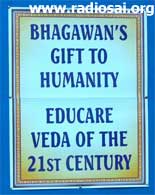
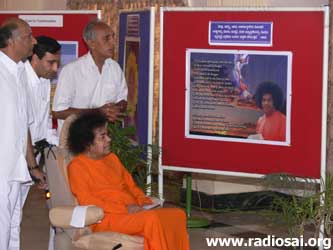
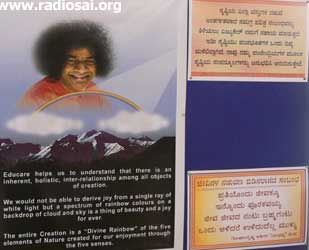
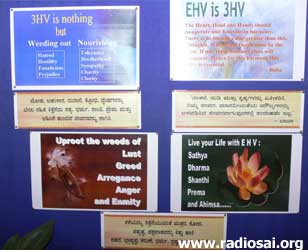
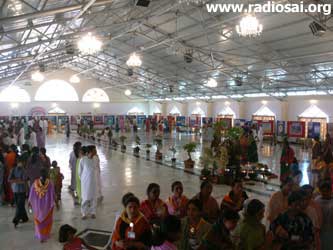
The exhibition contained a display of around 80 computer-generated posters and other exhibits to underline the message of Educare. The Kalyana Mantap was tastefully decorated in anticipation of Bhagavan's visit.
The first exhibition on 'Educare' was held at Brindavan two years ago, and all the posters were put on the website of the Sri Sathya Sai Books and Publications Trust, Prashanti Nilayam. For this second exhibition, all the English posters were accompanied by Kannada translations so as to make it easier for the Kannada-knowing people to understand and appreciate the message sought to be conveyed through the exhibits.
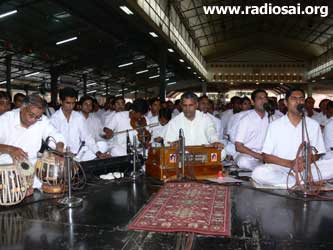
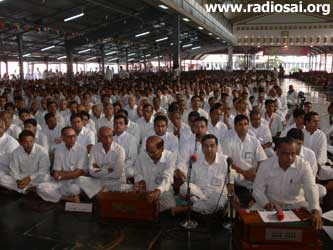
Bhagavan Sri Sathya Sai Baba's message of 'Educare', a synthesis of spiritual thought and practice, charts for us a clear way of life. It is proposed to take the display around the state in due course so that Bhagavan's message can reach an ever-widening circle of devotees MAY 25th: A CONCERT BY THE GENTS OF THE BRINDAVAN BHAJAN GROUP The Brindavan Bhajan Group has a fairly long history. Bhajans were initiated at Brindavan by Bhagavan on a regular basis during December 1968 after Swami returned from His trip to East Africa ... Initially, the lady members started the bhajan sessions with a few senior gents joining them. It was only in the year 1987 that male members also formally joined and formed a group after receiving the blessings of Bhagavan. The Brindavan Bhajan Group has since come a long way to the present structure wherein they form the back-bone of the bhajan singing especially during the summer months when Swami normally visits Brindavan.
On the same theme, "Sai Nama Kirtana Kaliyuga Sadhana", a comprehensive book giving insights on bhajan singing was also brought out by the Group along with an Audio-Visual CD during the 80th Birthday of Bhagavan, through the Karnataka Publications Trust. As a follow-up the group is now ready to present about 12 episodes of recorded Audio-Skit on Radio Sai Global Harmony to be aired shortly. This skit also highlights the significance and efficacy of namasankirtan.
2. Enu Daha Yava Moha (Kannada) There is an inexplicable thirst to see Him and a desire to sing His glory by His devotees. Let us become a bee which hovers around His feet humming His Name. 3. Govinda Shritha Gokula Brinda (Sanskrit) This song is a composition of Saint Annamacharya who extolled Govinda as Gokula Brinda. ...How fortunate are we to see the very same Sai Krishna in Brindavan! 4. Teliyaga Tarama (Telugu) Is it possible for mortals to understand and comprehend Bhagavan’s glory? Nay even Saints and Sages nor even Brahma can comprehend! But we can win His Love by singing His namasankirtan. 5. Nee Kaiya Bidade (Kannada) Hold our hands Oh Parteesha.....We contemplate on You everyday. We yearn to have Your Vision... How blessed are we to have Your darshan today! 6. Darshan Bina Sai Man Nahilage (Hindi) Oh! Sai, Your darshan is the greatest gift to your devotees. We yearn to see You and will imprint You in our Hearts. 7. Sai Ram Meghashayam (Telugu) Swami, You are both Sathyaswaroopa and Shanthi Pradeepa ... .Salutations to You Dear Lord. 8. Dekha Bhagavan - Dhanyavaad (Hindi) Swami, we would like to express our gratitude to You. Whatever we possess today is only by Your Grace. That we are singing today in Your presence itself is only by Your Grace. 9. Sai Nama Kirtanamu Kaliyuga Sadhanamu (Telugu ) Sai Nama Kirtana is the only effective sadhana in this Kali Age. Let us all then sing with bhava, raga and tala (feeling, melody and beat). . .
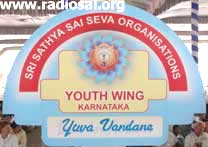
MAY 27th - 28th : YUVA VANDANA – A KARNATAKA YOUTH PROGRAMME
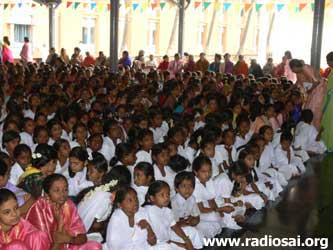
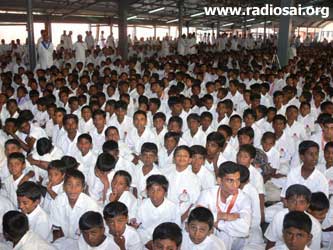
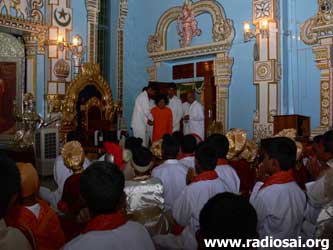
Every village boy dressed in a white pant and shirt and every village girl in a white salwar kameez, specially stitched and blessed by Swami earlier, were a sight to watch, as the children were so very happy. With all these youth and children, the energy levels were very high in Brindavan during the course of the two days.
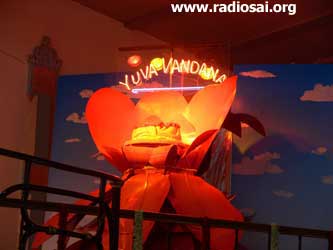
The Lotus flower after it opened revealed His Lotus Feet in the centre and was illuminated with the name of the festival YUVA VANDANA in bright letters on the top. The lotus was erected against the back-drop of a blue sky to provide a pleasing contrast
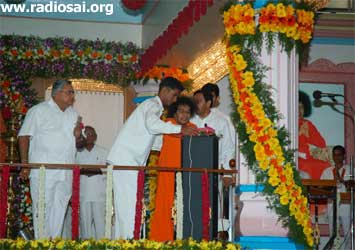
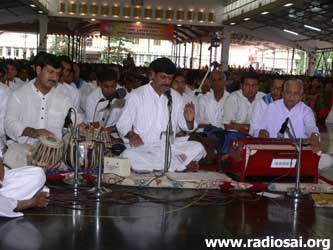
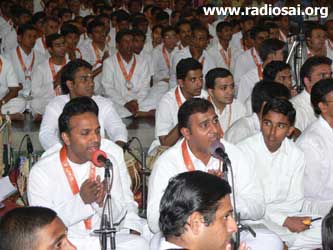
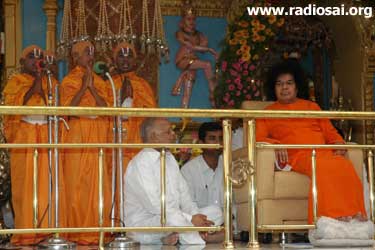
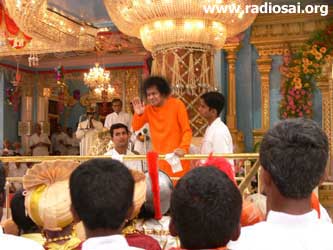
While Swami was inaugurating the function the youth continued singing the bhajans. They started with Ganesha Sharanam and followed it with the bhajans – Shakshatha parabrahma, Sarva Dharma Priya, Sri Kari, Jaya Panduranga, Hare Ram Hare Ram. They ended their bhajan presentation with Jaya Jagadeesha Hare and Bolo Bolo Sab Mil Bolo. Clearly the bhajan singers are very talented and Swami enjoyed their bhajan singing this morning and also on subsequent other occasions during this two-day festival, for it was their pleasant duty to sing the bhajans as Swami arrived into Sai Ramesh Hall both in the morning and the afternoon.
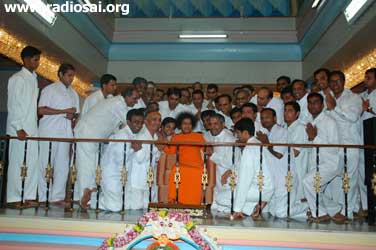
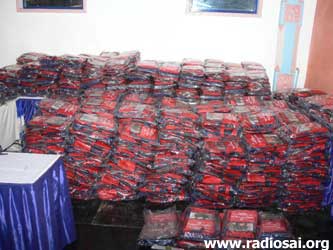
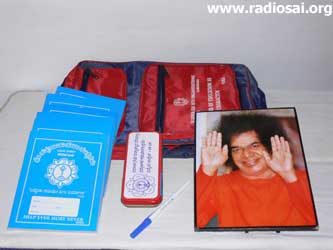
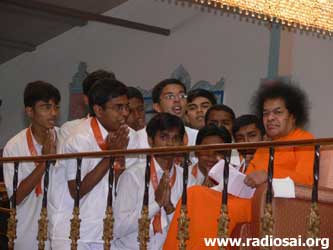
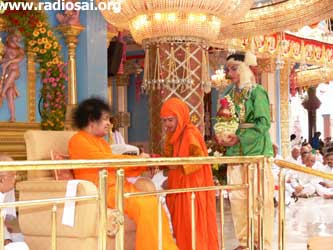
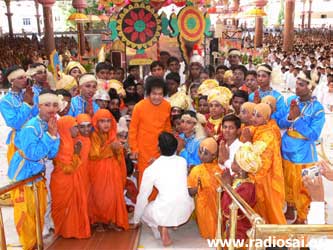
After inaugurating the function, and as the bhajan singing was going on, Swami expressed a desire to walk around the youth and the children. He blessed the distribution of the school kit to all the children, a timely gesture at the beginning of the school year. The school kit containing a school bag, 6 Note-books, a Geometry box, pens & Swami's laminated photograph were then distributed to all the 1000 children to their great joy, as a blessing from Bhagavan Baba, while Swami Himself stood observing and blessing all of them. Swami further blessed the school children and the Sai Youth by moving amidst them, giving darshan, sparshan and sambhashan before returning to the stage so that the morning’s festivities could begin.
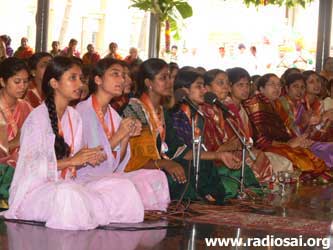
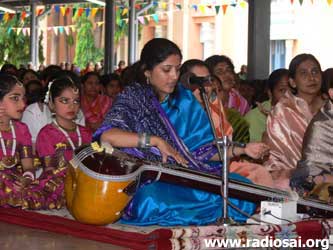
Swami permitted to start the programme with a theme song and a welcome song written by Sri Kasturiji and four little girls dancing to its melodious tunes. This was followed by music programme by Sri Shankar Shanbhogue and Smt. Smita Bellur and party. They gave a very scintillating performance singing compositions of Purandara Dasa, Meera and Basaveshwara. Sri Shankar Shanbhogue is an exponent in devotional singing and has learnt under the guidance of Pandit B. Radhakrishna Baliga, Pandit Mahabaleshwar Bhagwat, Pandit Madhav Bhat, Pandit Ramrao.B Naik, Pandit Raj Bhau Sontekke, and Pandit Panneshwar Hegde. Smt. Smita Bellur was initiated into Hindustani Classical Vocal Music at the age of 12 by Guru P.R. Bhagwat and continued her learning with Pandit Arjuna Nakod, a doyen of the Gwalior Kirana Gharana. Presently she is getting her classical taleem from Pt. Balachandra Nakod. And then suddenly without much fanfare the Lord was amidst them. Quickly He blessed the food that was going to be served to them - consecrating it as prasadam – a wholesome South Indian fare of sambar (thick lentil soup) rice cooked with vegetables; and also curd (yogurt) rice. He waited and continuously cast His beneficent gaze on all while the seva dal lovingly served these Narayanas, seated in rows with the ladies on one side and the gents on the other.
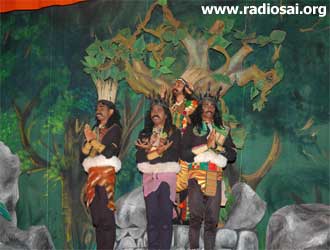
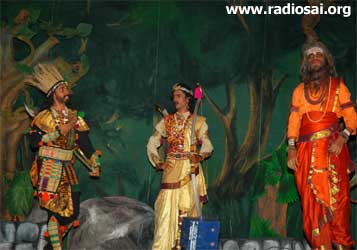
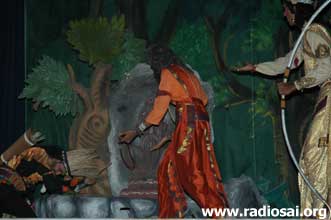
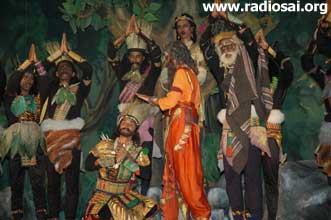
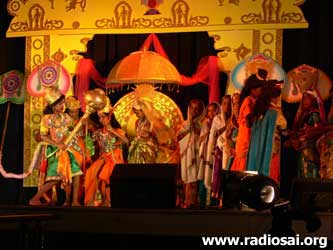
Immediately thereafter, Sai youths from Mysore enacted a play entitled "Ekalavya" in the Sai Ramesh Krishan Kalyana Mantap.
The confrontation between Arjuna and Ekalavya is electric and full of fast paced dialogue which was well appreciated by the Kannada speaking crowd. When Ekalavya hears about the guru’s promise to Arjuna, unhesitatingly he gives his right thumb to his “guru” Dronacharya as guru dakshina so that the guru could redeem his word to his disciple Arjuna of making him the greatest archer on earth.
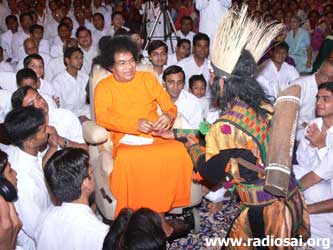
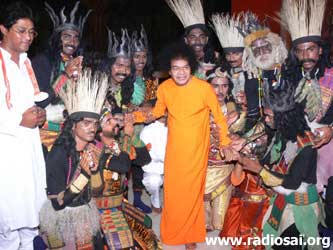
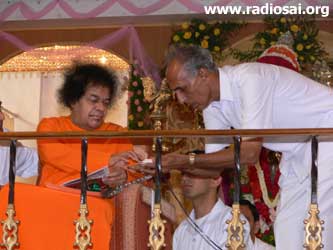
Swami watched the entire play and later personally handed over watches to each of the participants in the drama. Bhagavan Baba also expressed His immense happiness at the performance by creating a "Navaratna Ring" for Sri Kishen Bhagwat who enacted the role of Ekalavya. He also had a special word for the director of the play.
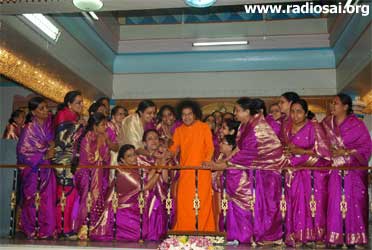
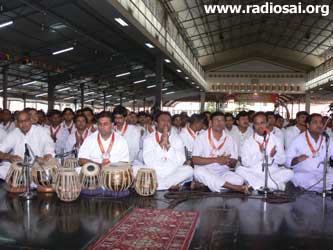
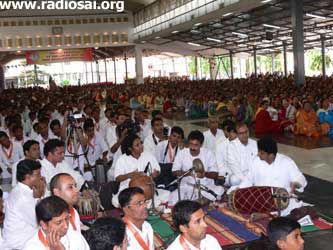
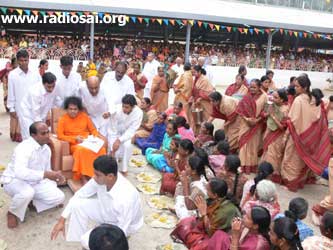
The Second Day’s Programme On Sunday, 28th May, bhajans were held by members of "Sai Gitanjali, Sri Sathya Sai Seva Kshetra" J.P. Nagar, Bangalore followed by Narayana Seva and vastra dana by Bangaloremahila seva dal (reported below). Talks were arranged in the morning for the Sai Youth in Sri Sai Krishen Kalyana Mantap. Sri B. N. Narasimha Murthy, Warden, Sri Sathya Sai Hostel; Sri Sanjay Sahani, Principal, Sri Sathya Sai Institute of Higher Learning; Sri. U. Gangadhar Bhat, Chairman, Sri Sathya Sai Loka Seva Institutions, Alike and Smt. Geeta Mohanram from U.S.A. addressed the Sai Youth. The afternoon session started with bhajans by Sai youth on the arrival of Bhagavan Baba. They were able to sing just two bhajans – Pasupathi Tanaya and Rasavilola Nandalala before Swami asked the afternoon programme to start. This was followed by two music programmes. First was a "Tala Vadya Kacheri" by Sri Arjun Kumar and party followed by instrumental fusion music by Sri Muthu and party. The Mridangam is one of the most ancient percussion instruments in India. It is considered a divine instrument as according to the Puranas, Lord Vishnu played the Mridangam during the Celestial dance, Tandava by Lord Shiva, while Goddess Saraswati played the veena, Indira the flute and Goddess Lakshmi was the vocalist.
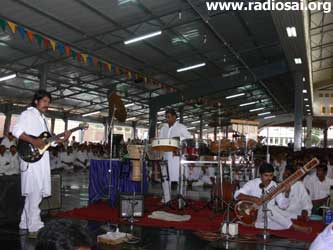
All of them took to the exposition of Aditalam which consists of eight mathras (syllables). Additionally, they made it interesting by telling the konnakol (which means saying the rhythm through the voice instead of the instruments). Needless to say this unusual fare was thoroughly enjoyed by all present in Sai Ramesh Hall. Wanting to continue to present a different fare rather than the usual run of the mill concerts, the organizers also contacted the fusion band River, led by Sri Muthu Kumar. Sri Muthu Kumar who is an alumnus of Swami’s Institute readily agreed at this golden opportunity to be in Swami’s presence. While Sri Muthu Kumar played on the tabla, Sri Ashok Iyengar provided the music of the Sitar, Sri Gopinath enthralled us on the drums, and Sri Praveen David formed the quartet on the guitar. The fusion band had four items. They started with the bhajan Manasa Bhajare Guru Charanam, and then classical fusion music with Raag Jogiya was presented next. Their rendition of Bhairavi was very enchanting and last but not the least they provided the back-ground music for the climax of that evening session where the youth offered the Yuva Vandana song sung by Dr.Anandkumar and Sri Sai Hariharan. This song composed in three languages (Kannada, Telugu and English) was set to tune by Sri Hariharan.
The words for the Yuva Vandana song are as follows:
The last sentence of the song in English, “We all have come to say we love You Swami” was rendered by more than two thousand youths assembled in Sai Ramesh Hall. At the close of the function, Bhagavan Baba stood up and expressed His immense happiness. Swami also announced that this was one of the best recitals and Swami assured the youths that He is always with them all the time. He appreciated the drama by the Medical students and called them on stage and posed again for a group photo with them. He appreciated the Sai Youth arranging such a drama and music programmes in such an efficient and appealing manner.
MAY 28th Morn: GITANJALI BHAJANS AND NARAYAN SEVA
They first paid homage to Lord Ganapathi with Sri Gananatha Gajanana and followed it up with the bhajans – Manasa Bhajare Guru Charanam, Akhanda Jyothi Jalao Sai Man Mandir Mein, Antaranga Sai Anathanatha Sai, Jai Jai Bhavani Maa Ambe Bhavani Maa, and Tripura Shiva Shankara. They also sang the bhajans Sathyanarayana Govinda Madhava, Rame Hare Sai Krishna Hare, Radhe Govinda Radhe Gopala Sairam, and Shambho Mahadeva Shiva Shambo Mahadeva. They concluded the morning session with the bhajans Radhe Govinda Bhajo Radhe Gopala Bhajo, Rama Sumira Man and the 13th and last bhajan of the morning was Jaya Vittala Vittala Vittala Jaya Vittala Panduranga. Swami then asked for the arathi to be taken so He could go on with the next activity that was dearer to His Heart – alleviating the distress of the poor.
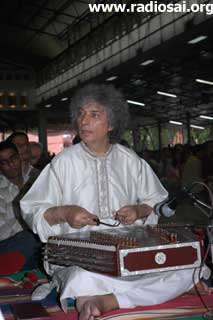
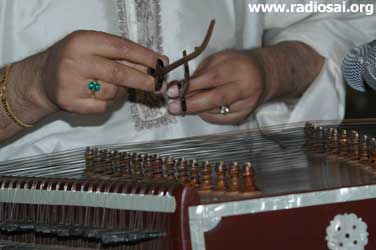
Santoor is a Persian word and it means a hundred strains. It is the oldest known string instrument of India. In Sanskrit it is called the shata tantri veena or "a hundred-stringed lute". The word 'veena' was used to describe all stringed instruments where the sound is created by maneuvering the taut string of a bow or pinaki. In the Rig Veda there is mention of the pinaki veena, which also happens to be the instrument of Lord Shiva.
MAY 31st: “SAI DARSHAN’S” PROGRAMMES IN SAI RAMESH HALL The Morning Programme May 31st was a red letter day for the devotees who belonged to “Sai Darshan”, a Sai centre in Indira Nagar, Bangalore. At a specially arranged function, they were able to regale the Lord with bhajans, apprise Him of their activities over the year and have Him inaugurate an addition to their centre building. They children of the centre also staged a drama in Sai Krishan Kalyana Mantap in the evening. Swami was welcomed to the Hall in the morning by the bhajans sung by the group. The bhajans that were sung by both the ladies and the gents that day included the following: Jai Jai Jai Jai Ganapathi Deva, Om Namo Bhagavathey, PurandaraRanga, Guru Brahma Guru Vishnu, Sri Ramachandra, Shiva Shiva Shiva, Karunasamudra Sri Rama, Hara Shiva Shankara, Shirdi Sai Dwarka Mai, and Amba Vandanam.
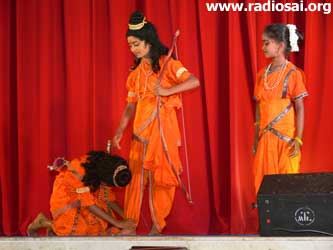
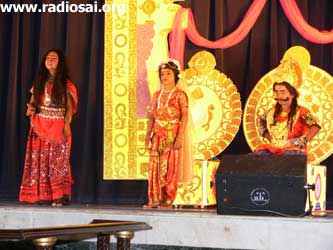
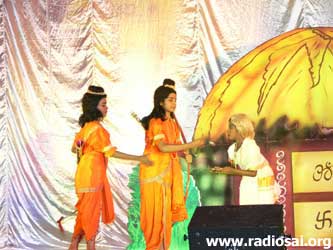
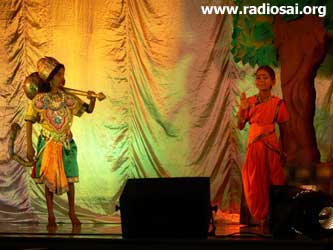
The Afternoon Programme In the evening after the normal darshan and bhajans in Sai Ramesh Hall, all of us quickly moved to Sai Krishan Kalyana Mantap for the children’s drama. The children of “Sai Darshan” enacted a play in Kannada called “Ramayanada Ramaneeyaru” based on the Ramayana. The play had a cast of 33 children – both boys and girls – and depicted sequentially the story of Rama’s exile for a period of 14 years and His triumphant return to Ayodhya and His coronation, following the death of Ravana in the epic battle. The play began with a scene where the ‘Bala Leelas’ and the growth into manhood of the four sons of Dasaratha were described. The next scene conveyed Mantara’s evil scheme of sending Rama into exile so that Bharata could ascend the throne of Ayodhya. Manthara succeeded by poisoning Kaikeyi’s mind to wring out from Dasaratha the two boons he had promised her many years earlier. Kaikeyi following through with this advice was depicted in a poignant tearful and tragic scene.
The play then showed Rama appropriately dressed up and getting ready to go to the forest. However, He finds that both wife Sita and brother Lakshmana want to accompany Him. All of them take tearful leave of mother Kausalya, Urmila and Sumithra. The episode of Shoorpanakhi being punished by having her nose cut off by Lakshmana, and Ravana vowing to abduct Sita against his wife Mandodari’s advise is next shown.
Moving on, the drama next showed Rama subjecting Sita to ‘Agni Pariksha’ – the test by fire – before receiving and accompanying her back to Ayodhya. In Ayodhya Bharata and Shatrugana anxiously await the arrival of Rama. The final scene showed Rama’s coronation and His assurance to the vanaras (the monkeys) that He would have them as His devotees in His future Avatar as Sri Sathya Sai Baba. The duration of the play was around 50 minutes and the children and everyone who had assisted with the play received Bhagavan’s blessings.
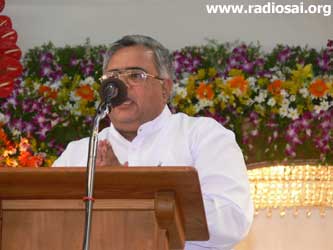
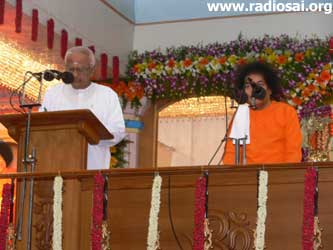
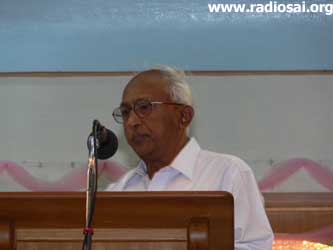
JUNE 1st: SPEECHES BY TWO ELDERS June 1st is the date the Institute opens after the summer vacation. Sai Ramesh Hall was abuzz with the new and returning students, all glad to be there and having Swami’s darshan. Normally when Swami is in Brindavan, He visits the College Auditorium in the morning on this day and blesses all the students there at the start of the academic year. This year however, He chose to visit the Vydehi Hospital in the morning, perhaps in response to the ardent prayers of its chairman who is a Sai devotee.
He also
stated that we can converse with God only in solitude. Hence we have to
observe silence and in that silence we can draw extra energy from Him to
help us solve our problems. We also have to get rid of our ego so that
God can open our eyes of devotion. In conclusion, he also talked about
the 4 letters:
Sri Krishnamurthy concluded by saying that when you lose everything that you have acquired in this world (i.e. material desires) then whatever you have not acquired (i.e. God) will be with you forever. So we should control the senses and be always happy in order to experience Him.
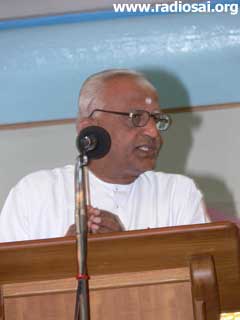
In conclusion, Sri Narasimhamurthy said, “Look behind and be grateful to God; look ahead and have trust in God; Look around and serve God; Look within and see God”. JUNE 8th: SWAMI RETURNS TO PUTTAPARTHI
On June
8th, Swami returned to Puttaparthi around 1:45 PM . For a few days
prior, He had been indicating to the students in Brindavan that He has
to return to Parthi as He had to oversee a lot of work. Parthi after all
is His office!
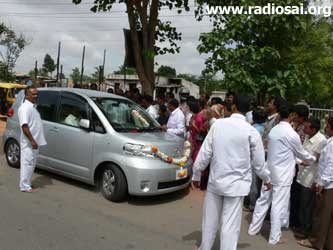
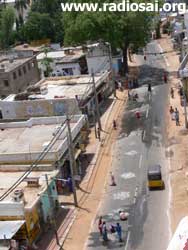
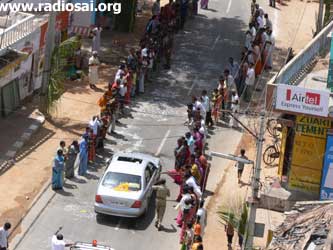
The news of Swami’s departure from Brindavan is immediately conveyed to Parthi, and within a matter of minutes the whole village comes alive. The roads leading into the village are washed by the women by pouring pots of water to wash away the dirt and make the black-top look clean and fresh. The women then decorate the cleaned roads with rangoli or floral patterns drawn using coloured chalk and letters in either Telugu or English welcoming Swami ‘home’. The men get busy making and tying buntings made of mango leaves across the road, a tradition in South India to welcome any eminent personality. And all of them after a bath assemble on the roads, occupying vantage positions, craning their necks so as not to miss even the slightest vision of the Lord as He returns home after His summer sojourn in Brindavan.
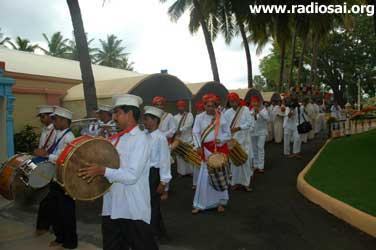
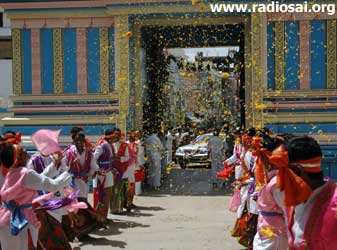
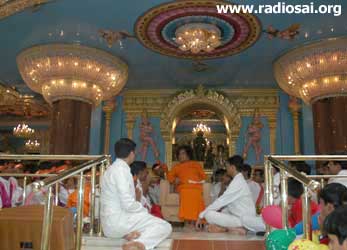
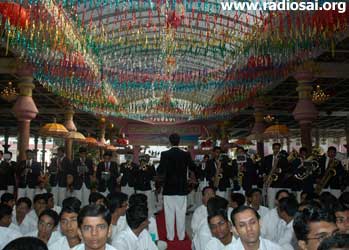
The Ashram is equally busy. Rangolis are drawn across the main entrance. Sai Kulwant Hall also wears a festive look as all the Ashram inmates and the students gather to welcome Him in a fitting manner. When Swami’s car enters the main road of town, palpable excitement manifests - for the soul of Puttaparthi is now back in residence. The bystanders vie with each other to catch the briefest of glimpses as His car zooms past. Some of the villagers also break coconuts in front of the car as a sign of auspiciousness. Slowly the car vends its way through the town and reaches the Ashram gates where a big crowd of devotees and students have assembled. As the car enters the Main gates, the vedam chanting boys and some of the boys dressed in bright coloured costumes are there to welcome Him and as His car enters it is showered with a cascade of flower petals. His car is slowly escorted to the middle of Sai Kulwant Hall and the kind and compassionate Lord though tired from the road trip still decides to sit for a few minutes on the dais giving joy to all before returning to His residence in Yajur Mandiram.
JUNE 18th: FELICITATION OF PROFESSORS
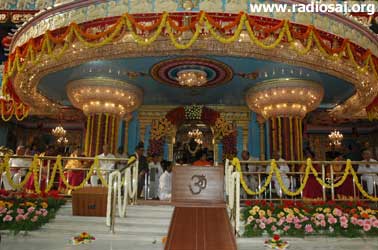
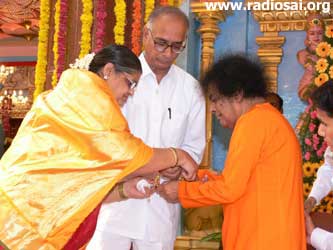
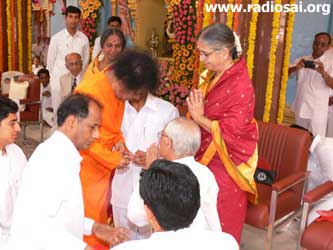
After returning from Brindavan, there was a little lull as far as public activities go. But suddenly on the 17th of June the entire Sai Kulwant Hall was in the process of getting decorated. Bright red-coloured embroidered cloth had been hung on the balcony and small pearl-like beads were strung along the entire veranda leaving everyone to wonder that perhaps a celebration was in the offing. And no-one was disappointed, for on the morrow a special ceremony had been arranged to felicitate a few eminent and long-serving teachers of the Sri Sathya Sai Institute of Higher Learning (SSSIHL) at Swami’s behest.
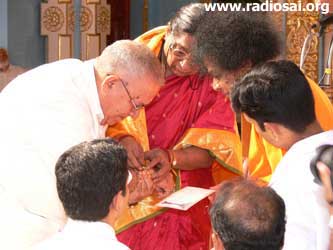
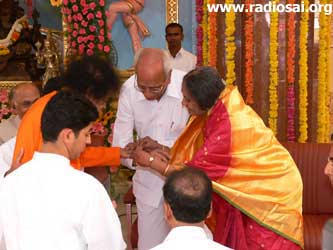
The Vice Chancellor Sri Anil Gokak welcomed the gathering and introduced the four teachers who were to be felicitated by Bhagavan that morning. They were: Prof. U.S.Rao, Prof. V.E.Ramamoorthy, Prof. M. Nanjundaiah and Prof. Vishwanath Pandit.
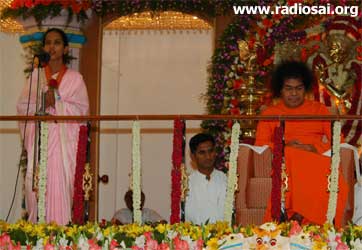
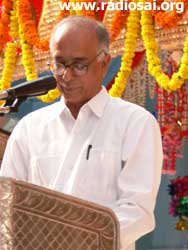
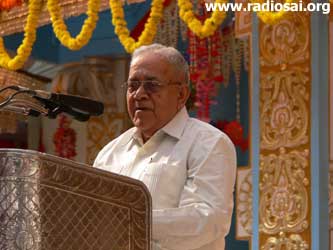
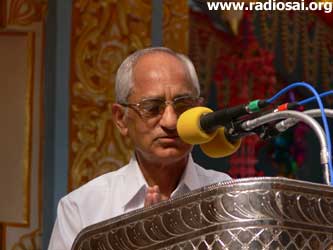
The first speaker was Prof. U.S.Rao, Principal of the Prashanti Nilayam Campus of the Institute and also the Dean of the School of Business Management, Accounting and Finance. Prof. Rao has had many years of experience in the industry having worked in reputed companies such as Jyothi Laboratories, Alfa Laval and Larsen & Toubro. He joined the Management Faculty in Bhagavan’s college in the year 1988. He has published several articles in national and international journals, and his zeal and energy for academic excellence has remained undiminished through all these years. He began his talk by expressing his gratitude to Bhagavan who blessed his wife and him with an extension of life 17 years ago. He remarked, “I am also grateful to Bhagavan for making me a teacher in his great educational Institution which shapes and moulds His students into leaders of tomorrow to carry out His mission. I am also very fortunate to teach and interact with good-natured students selected by Him. Their enthusiasm, sincerity, idealism, faith and love for Bhagavan is contagious and spreads to all those who deal with them. Can there be a better atmosphere and nobler profession than that?” He also stated that the Annual Sports and Cultural Meet is an example of their love for Him and His love for them. He added, “The impact of the transformation in the students is that they slowly begin to rely on the power of the divine rather than on the power of the physical and the material world. This can be achieved only by the Divine”.
The second speaker, Prof. V. E. Ramamoorthy, is a qualified cost accountant and has taught in prestigious institutes like the Institute of Financial Management and Research (IFMR), and the Administrative Staff College of India (ASCI), Hyderabad. He was the Director of Management Development Institute for South Asian region. He has authored several books on Working Capital Management. Prof. Ramamoorthy said, “1993 is a memorable year for my wife and I for that was the year Swami brought us to His Lotus Feet. Having had our share of the ups and downs of life, we were praying for a retired life of reasonable health, peace and quiet. For the last 12 years we have had uninterrupted health, happiness and peace. This has been the golden phase of our lives for which we are very grateful to Him. What greater boon can there be than being able to serve in God’s own temple of higher learning which has a wide reputation as the crest jewel of the institutions of higher learning of any country. What greater boon can there be than to associate oneself with the students – God’s own chosen ones who are academically and spiritually alert and active. In the contemporary world the counterparts of the students shun devotion; but here when I listen to their whole hearted and full throated participation in the morning bhajans and when I witness the spiritual themes they present before Bhagavan and the innovations they bring in and their participation in cultural events like the Grama Seva, it is not only heart-warming but soul stirring”.
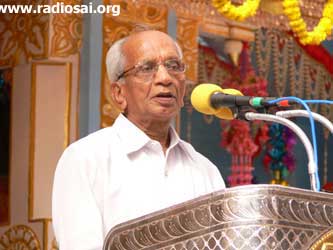
The next speaker was Prof. M. Nanjundaiah, Controller of Examinations, Sri Sathya Sai Institute of Higher Learning. Prof. Nanjundaiah came to Swami in the year 1973 when he joined as a Reader and the Head of the Commerce Department in the erstwhile Sri Sathya Sai College of Arts, Science and Commerce at Whitefield, affiliated to the Bangalore University. He said, “Sai has a very unique relationship with each and everyone. With me the relationship is that of a mother. When She personally told me that you should not go on changing your relationship with Me – choose one thing and stick to it. This was way back in 1974 and from then onwards it has been Mother Sai for me. It is difficult for me to convey the deep sense of feeling when way back in 1973, I asked Him for the opportunity to serve in His Institute. What I had in mind was to be an honorary part-time teacher coming from Bangalore and teaching in the Whitefield College. In 2 months from that day I became a Reader in Commerce and the Head of the Department and then commenced the most wonderful period of my life. Those days Swami used to spend a lot of time with the students in Brindavan. What greater joy than to see the incessant flow of love between Swami and His students!” He further quoted an incident of how Swami transformed the behaviour of a boy by stopping to talk with him and also revealing His omnipresence. Such lessons, he said are innumerable and Swami always guides His students. In this context he gave the example of the involvement of Swami in the Bhajagovindam drama that became a big success. He also mentioned the immense help and guidance that Swami gave him, as a mother, when he made the transition from teaching to administration. He further mentioned the guidance that Swami gave him through letters specifically mentioning how Swami wrote to him telling him how he could be a good family man and a devotee.
The last speaker was Prof. Vishwanath Pandit, Head of the Department of Economics in the Prashanti Nilayam Campus of the Institute. Prof. Pandit is a renowned economist who has been on the faculty of the Delhi School of Economics. He has also been associated with Pennsylvania University, USA and Manchester University, UK, and also with various projects in the UN and the World Bank. He was the President of the Indian Economic Society and the recipient of the UGC (University Grants commission) Swami Pranavananda National Award 2004 for his contributions in the field of economics. With his characteristic humility he said, “The magnanimity of the most compassionate Lord is indeed limitless. It is here today for all to see. I have no doubt in my mind that having been permitted to serve Him at the SSSIHL and to stay close to His Divine Lotus Feet is much more than what I have ever deserved and much more than what I have ever asked for. The torrential grace that has been showered on us today is really overwhelming. There are no words for me to adequately express my gratitude to Bhagavan.” Sharing a couple of his thoughts, Sri Pandit said that though he joined the SSSIHL only in 2001, he was associated with it right from 1986 when he was asked to set the entrance test question paper for the new School of Management. He came a number of times over the years and spent his summers in Prashanti Nilayam helping out wherever he could, but it was only when the Master Programme in Economics was announced in 2001 that Swami deemed the time right for him to come to Prashanti Nilayam. He said that it was very fulfilling for him to interact with the students whom Swami referred to as His only treasure and the role models of tomorrow. He concluded by praying to Bhagavan to always let everyone remember and be aware of His Divinity and Grace.
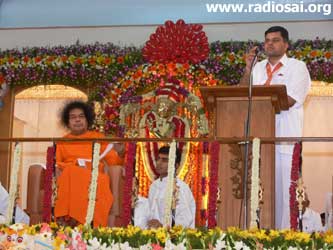
Dr. Deepak Anand, an alumnus of the Institute and presently on the Management faculty spoke on behalf of all the students expressing appreciation and gratitude to the teachers for their invaluable guidance in shaping the careers and personalities of hundreds of students. Quoting verses from the Taittriya Upanishad he surmised that in this University the teachers and the students learn the lessons of life in the presence of Bhagavan in the spirit that living with God is true education. He led the entire gathering in applauding the achievements of these eminent educationists, in turn.
Swami then sat down and all of us were requested to rise for the National Anthem. After a few bhajans, Swami received arathi and retired to His Yajur Mandiram residence. All the students and staff had a sumptuous lunch in the South Indian canteen that had been so lovingly arranged by Swami.
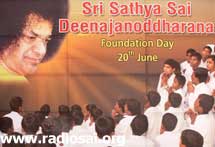
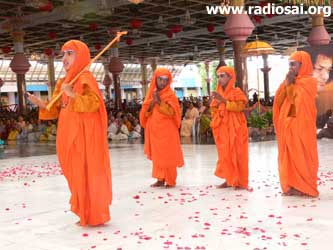
The sum of Rs.100,000 has been deposited in the name of each child (which would be given to them along with the interest when they reach adult age); additionally free housing, food, clothing, education and other daily needs are being provided to them in a loving environment. The residential units are located in a colony named Sri Sathya Sai Nagar in the village of Kammavaripalli behind the western perimeter of the ashram. A school also has been built here where the children are provided formal education along with vocational training. This institution has now become a role model for many such institutions in Andhra Pradesh. On the evening of 20th June 2006, the children of the home celebrated the fourth anniversary of their foundation day in the divine presence of Bhagavan. The students in their costumes and makeup were seated in the Bhajan Hall. Swami came for darshan at 3.30 pm, and directly came to the Bhajan Hall to see them. Swami asked about some of the costumed characters and spent a few light moments with them, and then instructed them to go and get ready to start the programme. Bhagavan took His place on the dais at 3.55 p.m and was ceremoniously welcomed by 2 actors from the drama
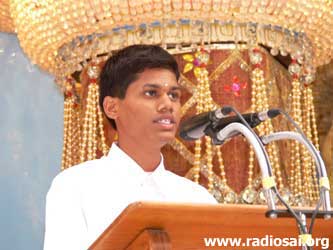
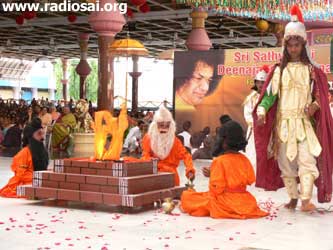
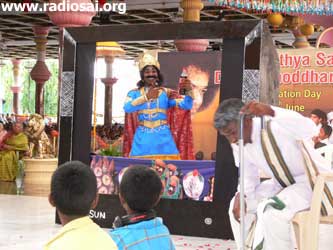
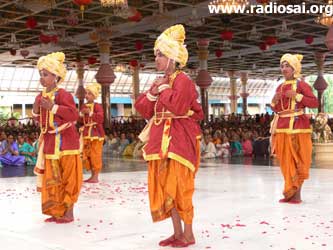
The programme began with an invocation by the DJP students who chanted the ‘Narayana Suktam’. At the outset, a boy from the Institution described in English the love and care of Sai and expressed his gratitude to Bhagavan for providing them food, clothing and a safe haven to live in. “We can only offer ourselves and pray for His grace”, he said. The boy informed the audience that 9 boys had passed the 10th class and some others had done so well that after finishing the intermediate they had joined B.Sc. in Information Technology to pursue their further studies. After the speech came the thematic skit which was interwoven with songs and dances, Bhagavan's teaching that technology and all resources must be used for social welfare, was the central theme that was conveyed by the boys through the 3 episodes with 2 boys as narrators providing a commentary. The sets included a giant TV set and a homa kunda, both of which were innovatively and realistically rendered apart from a back-drop that conveyed Swami’s love for the boys and their love for Him.
The opening scene depicts Adi Sankara eulogizing Lord Siva. The narrators in their commentary set the tone by deploring that in this holy land that has given birth to such great men of wisdom like Adi Shankara, society has today fallen to the lures of the materialism and ignored its past glorious heritage. This was followed by a dance that was well rendered by the boys who had obviously practiced hard to get the steps right and please the Lord.
The next
scene portrays a few priests performing a
Yagna (offering of oblations in
the sacrificial fire) when the great emperor Alexander on his conquering
expedition happens on the scene. He is angry at the priests for they
ignore him and are unimpressed by his glory. Alexander converses with
the priests and questions them if they have not heard about his
conquests of vast parts of the world. The priests reply that they are
not interested in such useless information when they have embarked on
the grand adventure of realizing God. Alexander is impressed by their
self confidence and simplicity and asks them to reveal the secret of
their contentment. The priests reply that true happiness can be gained
only by conquering one’s desires and not by conquest of empires.
Then the boys portray a typical urban household in India. The family elder who prides in the richness of Indian culture is shocked at seeing his grandson’s flippant attitude towards the values and ethos of this great land. He teaches his grandson that the wonders of modern technology that he was so much in awe of were already known to the sages of ancient India. He cites examples such as the ancient Indian treatise on air travel as well as missiles and warheads, Vaimanika Sastra, and various surgical procedures detailed in the Charaka Samhita. He explains to the boy that it is not technology that is evil, but it is the harmful ways in which it is being applied. The play brought out the numerous ways that technology, especially Information Technology, can benefit society. It is only spirituality that can lend completeness to science was the message of the skit.
The
presentation concluded with a moving song that expressed the gratitude
the boys felt towards Swami for the sea change that Swami had brought
about in their lives and Who cared for them as only a loving mother can.
At the end of the programme, Bhagavan lovingly granted photographs to
the boys. Swami lingered on for a while blessing the boys profusely
while prasadam distribution (of
a mango) was going on. Clearly He was very touched at this programme the
boys had put up and all of us were also impressed to see the difference
that love can make in a person’s life and put them well on the God ward
path.
We will stop this month’s chronicles here. In the early part of July Prashanti Nilayam will again be pleasantly invaded by youth; this time it will be teenagers from the States of Maharashtra and Goa jubilantly celebrating the festival of Ashada Ekadashi in the divine Presence. And of course, four days after that will be the Guru Poornima festival. Join us again next month to read about all these exciting events along with their colourful pictures. So till next time; Jai Sai Ram. - Heart2Heart Team |
source: http://media.radiosai.org
Home | SBOI-Group| Pictures | Audio-Video | Wallpapers| Greeting-cards | Ashrams Info. | Sai news