|
"There are many who
argue that the Pranava can be repeated only by a few, and that
others are not entitled to it. This is wrong. This false conclusion
has been arrived at since they do not know the Truth. It springs
from a mistaken belief. The Gita does not mention this group or that
group. Krishna declares 'whoever' without any qualifying words
limiting it to one class or sex."

"The Gayatri Mantra is the
elaboration of the Pranava Sabda or Om. It (the Gayatri Mantra) is
now held so venerable and valuable that initiation into the
Adhyatmic life is achieved by its contemplation."
1. What is the
Gayatri Mantra?
The Gayatri Mantra is the Universal Prayer enshrined in the Vedas,
the most ancient Scriptures of Man.
The Gayatri Mantra is a Prayer that can well be spoken with yearning
by men and women of all creeds and climes in all centuries.
Repetition of this Mantra will develop the Intelligence.
2. Recite the
Gayatri Mantra.
The Gayatri Mantra is as follows:
OM BHUR BHUVA SUVAH
TAT SAVITUR VARENYAM
BHARGO DEVASYA DHEEMAHI
DHIYO YONAH PRACHODAYAT
Bhagavan chanting
Gayatri Mantra:
Download/listen Swami singing the Gayatri mantra (137K)
once,
twice, nine times,
with
background music (mp3 files)
3. How may the
Gayatri Mantra be translated?
OM
- Para Brahman
BHUR
- Bhu loka (Physical plane). It also refers to the body made up of
the 5 Pancha Bhutas (5 elements). These 5 elements constitute
Prakriti (Nature).
BHUVA -
Bhuva loka - The middle world. Bhuva is also Prana Sakthi.
SVAHA
- Swarga loka (Heaven - the land of the Gods)
TAT
- Paramatma, God or Brahman
SAVITUR
- That from which all this is born
VARENYAM
- Fit to be worshipped
BHARGO
- The Radiance, the Spiritual Effulgence, the Light that bestows
Wisdom
DEVASYA
- Divine Reality
DHEEMAHI
- We meditate
DHIYO
- Buddhi, Intellect
YO
- Which
NAH
- Our
PRACHODAYAT
- Enlighten.
The Gayatri Mantra may be
translated in many ways. One such translation is as follows:
We meditate upon the Spiritual Effulgence of that Adorable Supreme
Divine Reality the Source of the Physical, the Astral and the
Heavenly Spheres of Existence. May that Supreme Divine Being
enlighten our intellect (so that we may realise the Supreme Truth).
4. Who discovered
the Gayatri Mantra?
The Gayatri Mantra was discovered by Sage Viswamitra. It was the
same Sage Viswamitra who initiated Sri Rama into the mysteries of
Sun worship, through the Mantra Aaditiya Hrdayam.
5. What did the
Gayatri Mantra enable Sage Viswamitra to do?
The Gayatri Mantra enabled Sage Viswamitra to use rare weapons,
which bowed to his will when the Mantra was repeated with faith.
Through the powers he attained in this way, Viswamitra was able to
create a counterpart of this Cosmos. (Sathya Sai Vahini - 184)
6. To whom is the
Gayatri Mantra addressed?
The Gavatri Mantra is addressed to the energy of the Sun, Surya.
7. What is the
potency of the Gayatri Mantra?
This Mantra has infinite potentiality. It is a vibrant formula. It
has immense powers, powers that are truly amazing, for the Sun is
its presiding Deity.
8. Where is the
Gayatri Mantra enshrined?
The Gayatri Mantra is enshrined in the Vedas, the most ancient
Scriptures of Man.
9. Who is Gayatri?
Gayatri is the Mother of the Vedas -
Gayatri Chandasaam Maatha.
10. Whom does
Gayatri redeem?
Gayatri redeems the chanter of the Mantra -
Gaayantham thraayathe ithi Gayatri.
11. Where is
Gayatri present?
Gayatri is present wherever the Mantra is chanted.
12. What are the
three Names of Gayatri?
Gayatri has 3 names - Gayatri, Savitri and Saraswathi. These three
are present in each one of us. Gayatri is the master of the senses.
Savitri is the master of Prana (Life Force). Savitri signifies
Truth. Saraswathi is the presiding Deity of Speech (Vaak). These
three represent purity in Thought, Word and Deed (Trikarana Suddhi)
(One who practises purity and harmony of Thought, Word and Deed will
have Gayatri, Savitri and Saraswathi residing in him.)
13. To whom is the
Gayatri Mantra addressed?
The Gayatri Mantra is addressed to the Immanent and Transcendent
Divinity.
14. What name has
the Immanent and Transcendent Divinity been given?
The Immanent and Transcendent Divinity has been given the name 'SAVITHA'.
15. What does 'SAVITHA'
mean?
'SAVITHA' means "that from which all this is born".
16. How many parts
may the Gayatri Mantra be considered to have?
The Gayatri Mantra may be considered to have 3 parts. The Mantra has
all the three elements that figure in the adoration of God - Praise,
Meditation and Prayer. The first nine words represent the attributes
of the Divine:
" OM BHUR BHUVA
SVAHA
TAT SAVITUR VARENYAM
BHARGO DEVASYA "
" DHEEMAHI "
pertains to Meditation.
" DHI YO YONAH PRACHODAYAT " is the Prayer to God
to confer on us all powers and talents.
17. What may these
3 parts also be described as?
The three parts may also be described as:
(1) Praise to Savitha. The Divine is first praised.
(2) Meditation on Savitha. The Divine is then meditated upon in
reverence.
(3) Prayer to Savitha.
An appeal is made to the Divine to awaken and strengthen our
Intellect, the discriminating faculty (Buddhi) in us.
18. What is the
Gayatri Mantra considered to be?
The Gayatri Mantra is considered to be the Essence of the Teaching
of the Vedas - the Veda Sara.
19. What does the
Gayatri Mantra foster?
Chanting the Gayatri Mantra fosters and sharpens the
knowledge-yielding faculty in man.
20. What are the
other benefits to one who chants the Gayatri Mantra?
To one who chants the Gayatri Mantra regularly and with faith -
the Gayatri Mantra is the
reliever of diseases -
Sarva roga nivaarini Gayatri,
the Gayatri Mantra wards
off all misery -
Sarva duhkha parivaarini Gayatri,
the Gayatri Mantra is the
fulfiller of all desires -
Sarva vaancha phalasri Gayatri.
21. What does the
Gayatri Mantra bestow on the person who chants it with faith?
The Gayatri Mantra is the bestower of all that is beneficial to the
person who chants it with faith.
22. What are the
other results of chanting the Gayatri Mantra?
If the Gayatri Mantra is chanted various kinds of powers will emerge
in one. Hence the Gayatri Mantra should not be treated casually.
23. What is Truth?
Truth is that which is valid at all times past, present and future.
That Truth is the Gayatri Mantra.
24. What does the
Gayatri Mantra imply?
The Gayatri Mantra implies the 4 Maha Vakyas or the Four core
declarations enshrined in the Four Vedas.
25. What are the
four Maha Vakyas?
The four Maha Vakyas are:
1. PRAJNANAM BRAHMA
Consciousness is Brahman (Aitareya Upanishad of the Rg Veda)
2. AHAM BRAHMA ASMI
I Am Brahman (Brihadaranyaka Upanishad of the Yajur Veda)
3. TAT TVAM ASI
That Thou Art (Chandogya Upanishad of the Sama Veda)
4. AYAM ATMA BRAHMA
This Self is Brahman (Mandukya Upanishad of the Atharva Veda)
26. When should the
Gayatri Mantra be chanted?
The Gayatri Mantra should be chanted at dawn, noon and dusk.
27. What are these
times also known as?
These times are also known as Sandhya Kaalam, that is to say, the
meeting point between night and day, morning and evening, day and
night. These times are beneficial for spiritual practices.
28. Do we have to
be bound by these periods of time to chant the Gayatri Mantra?
No, we do not have to be bound by these three periods of time to
chant the Gayatri Mantra.
29. When can the
Gayatri Mantra be chanted?
The Gayatri Mantra can be chanted at any time and everywhere.
30. What should the
person chanting the Gayatri Mantra ensure at all times?
The person chanting the Gayatri Mantra should ensure that his heart
is pure at all times.
Bhagawan's injunctions are that we should -
(1) not treat the Gayatri
Mantra casually (Q 22) and
(2) that our heart should
be pure at all times. We should therefore obey and practice
implicitly Bhagawan's Teachings. (These are to be found in Summer
Showers 1990. Briefly, they are as follows:)
1. Speak Truth.
Attach value to your words. Truth is the life of a word.
2.
Practise Righteousness. How ? By developing
Trikarana Suddhi (Q12).
3. Purity and
Harmony of Thought, Word and Deed.
Think no evil - Think what
is good
See no evil - See what is good
Hear no evil - Hear what is good
Talk no evil - Talk what is good
Do no evil - Do what is good
4. At all
times follow Bhagawan's maxim -
Help ever - Hurt never.
5. Dedicate all
your actions to the Lord -
without undue concern for the results, and without the false sense
of doership ("I am the doer").
31. What is
Bhagawan's advice to young people?
Bhagawan's advice to young people is that they should chant the
Gayatri Mantra when taking their bath.
32. Why does
Bhagawan recommend this?
Bhagawan says that when we take our bath, we are cleansing our
bodies. Therefore, we should take this opportunity to cleanse our
minds and intellects also at the same time.
33. At what other
times does Bhagawan recommend that we chant the Gayatri Mantra?
Bhagawan recommends that we chant the Gayatri Mantra
(1) before every meal
(2) when we wake up from bed
(3) when we go to bed.
34. What should we
repeat after chanting the Gayatri Mantra?
We should repeat 'Santhi' three times after we finish chanting the
Gayatri Mantra.
35. Why should we
repeat 'Santhi' after completing our recitation of the Gayatri
Mantra?
We should repeat 'Santhi' because it will give 'Santhi', or peace of
mind, to the three entities in us - body, mind and soul.
36. Bhagawan taught
the Gayatri Mantra and its importance to Sri Fanibunda. What are the
main points in Bhagawan's Teaching?
Bhagawan's Teachings to Sri Fanibunda are given in his book "Vision
of the Divine". The main points are -
1. If the Gayatri Mantra is
not recited correctly, it has the adverse effect of enveloping the
person in darkness. But, if we
recite it with Love, God will accept it.
Bhagawan Sri Sathya Sai
Baba chanting Gayatri Mantra:
1.Without chorus: gayatri.wav (18 seconds, 191 KB, WinPCM)
2. With chorus: gayatri.mp3, (32 seconds, 125 KB, MPEG 1.0 layer 3)
2. Baba advises that
each word should be pronounced clearly
and distinctly, without undue haste or hurry.
3. Gayatri is at the very
basis of the Vedas, and merits the name Veda Mata or The Mother of
the Vedas. The Gayatri Mantra is all-pervasive throughout the
manifest Cosmos.
4. Gayatri is "That
which preserves, protects and rescues the chanter from mortality".
5. The Gayatri Mantra is a
Universal Prayer, which asks
for a clear Intellect so that the Truth may be reflected therein
without distortion.
6. Bhagawan has said that
the Gayatri Mantra can be
chanted by men and women of all climes and creeds.
It calls upon the Glorious Power that pervades the Sun and the Three
Worlds to arouse, awaken and strengthen the Intelligence, so that it
may lead us through intense Sadhana to success.
7. The heart needs
to be cleansed thrice a day - dawn, noon and dusk. Besides
these times, Bhagawan has said that the Gayatri Mantra can be
repeated anywhere at any time, including night time.
8. The Gayatri Mantra is
synonymous with Divinity and has therefore to be approached with
humility, reverence, faith and love towards the Mantra.
9. The Vedas are the very
breath of God and the Gayatri
Mantra is at the very basis of the Vedas.
10. Bhagawan is the
Vedapurusha and is therefore the Supreme Authority on the Vedas.
11. Love and
reverence for the Mantra and faith in its promised results are far
more important than mere mechanical repetition while the
mind wanders.
12. This prayer is directed
to the Divine Mother -
"O Divine Mother, our hearts
are filled with darkness. Please make this darkness distant from us
and promote Illumination within us".
13. Full faith in
the power and potency of the Gayatri Mantra will be generated only
when the seeker has developed the requisite degree of enthusiasm,
reverence and love towards this Mantra.
14. The more one
chants the Gayatri Mantra, the greater the benefit to the one who
chants it.
37. How does man
misuse his life?
Man forgets his true nature owing to his attachment to his body. He
makes bodily comforts the goal of his life and involves himself in
misery. The body is a car and the Atma is the driver. Forgetting
one's true role as a driver, one identifies one's Self with the
body, which is only a vehicle. (SS 9/95-233,234)
38. What should
man's life be?
Man's life should be a continuous series of sacrifices of the lower
for the sake of the higher, or of the tiny in favour of the vast.
39. What cannot our
two eyes reveal to us?
Our two eyes are focused towards the objective world and its
transient attractions. They cannot therefore reveal the magnificence
and the majesty of the realm of the Spirit.
40. For what
purpose has the Gayatri Mantra been given to us?
The Gayatri Mantra has been given to us as the Third Eye (the Ajna
Chakra) - to reveal the inner vision to us. By developing this inner
vision, we may realise Brahman.
41. Why should we
guard the Gayatri Mantra throughout our lives?
The Gayatri Mantra is a treasure and we must therefore guard it
throughout our lives. We must learn to pronounce and chant the
Gayatri Mantra correctly and exactly as taught by Bhagawan.
42. What should we
never give up?
We should never give up the Gayatri Mantra. That is to say, we must
chant the Gayatri Mantra at least a few times every day with a pure
heart.
43. What may we
give up?
We may give up or ignore any other Mantra, but we should never give
up the Gayatri Mantra throughout our lives.
44. What benefits
can we derive by chanting the Gayatri Mantra several times a day
with a pure heart?
The Gayatri Mantra will protect us from harm wherever we are,
whether - in a bus or car, in a railway train or a plane, in a
bazaar or on the road.
45. What have the
Westerners discovered about the Gayatri Mantra?
The Westerners have discovered that when the Gayatri Mantra is
chanted with the correct accent as laid down in the Vedas; the
atmosphere around is visibly illumined by the vibrations produced by
the Gayatri Mantra.
Bhagawan tells us: "The Sound of a Mantra is as valuable as its
Meaning". (We should therefore learn to chant the Gayatri Mantra
correctly as taught by Bhagawan.)
46. What spiritual
benefits will we derive by chanting the Gayatri Mantra?
The effulgence of Brahma - Brahmaprakasa, will descend on us,
illumine our intellect and light our spiritual path when we chant
the Gayatri Mantra correctly as taught by Bhagawan.
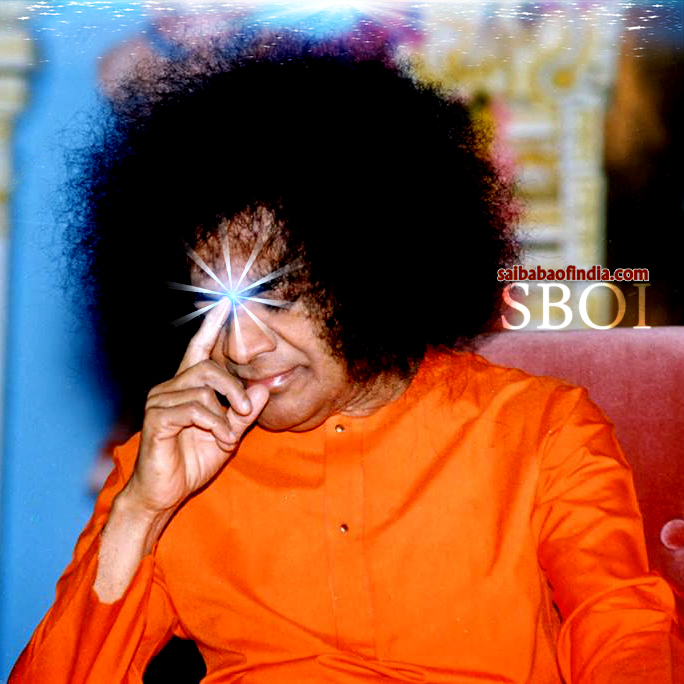
While chanting the Gayatri Mantra, we may be well advised to follow
the Instruction that Lord Krishna gave to Arjuna in the Bhagavad
Gita V - 27 "Shutting out all sense perceptions, and fixing the gaze
between the eye-brows..."
47. How often
should we chant the Gayatri Mantra?
Bhagawan has said that we should chant the Gayatri Mantra as often
as possible.
See also Q 36 Item 14 - "The more one chants the Gayatri Mantra, the
greater the benefit to the one who chants it."
We should chant the Gayatri Mantra at least 108 times (One Mala)
every morning. This will take only 15 minutes.
Those who take up to the chanting of the Gayatri Mantra as a Sadhana
by itself may chant 3 or, preferably, 5 Malas every morning and an
equal or lesser number of Malas in the evening. Chanting 10 Malas (2
1/2 hours) every Sunday morning and on holidays is not beyond the
capacity of the earnest Sadhaka. Gayatri purascharana consists in
chanting 10 Malas each morning for 24 or 40 days without a break.
To absorb the Mantric power, purity of life and an abstemious diet
are essential.
48. What is the
result if we chant the Gayatri Mantra while taking a bath or before
taking our food?
If we chant the Gayatri Mantra while taking a bath, our bath gets
sanctified. If we chant it before taking our food, our food becomes
an offering to the Divine. We should develop heartfelt devotion to
God. (SS 9/95-238)
49. Who is Gayatri?
Gayatri is Annapurna, the Divine Mother, the Divine Force that
animates all Life.
50. Gayatri is
described as five-faced. What are they?
The five Faces of Gayatri are:
1. "Om",
the Pranava is the 1st Face. The Pranava Principle represents the
eight different forms of wealth (Ashta Aiswarya).
2. "Bhur Bhuva Svaha"
is the 2nd Face.
3. "Tat Savitur Varenyam" is the 3rd Face.
4. "Bhargo Devasya Dheemahi" is the 4th Face.
5. "Dhi Yo YoNah Prachodayat" is the 5th Face.
All these five aspects of the Gayatri Mantra are within each one of
us. (SS 9/95-235) See also Q 12
51. Why should we
take up the Gayatri Mantra and chant it unceasingly?
We should take up the Gayatri Mantra and chant it unceasingly,
because -
(1) The Gayatri Mantra will protect us from harm wherever we are,
whether - in a bus or car, in a railway train or in a plane, in a
bazaar or on the road.
(2) Brahmaprakasa (the effulgence of Brahman) will descend on us and
illumine our spiritual path when we chant the Gayatri Mantra.
52. How does the
Gayatri Mantra protect us?
The Gayatri Mantra protects us because Gayatri is Annapurna, the
Mother, the Force that animates all Life. We do not therefore have
to wail for food or for shelter when we are under the protection of
Annapurna, the Divine Mother.
(We should therefore chant the Gayatri Mantra as often as possible.
The more we chant the Gayatri Mantra, the greater the benefit to
us.)
53. Do we need any
protection other than what we can get by chanting the Gayatri
Mantra?
No. Bhagawan tells us that the Gayatri Mantra is enough to protect
the person who chants it. (SS 9/95-237)
54. Why is the
Gayatri Mantra enough to protect the person who chants it?
The Gayatri Mantra is enough to protect the person who chants it
because, as Bhagavan tells us, the Gayatri Mantra embodies all the
Divine Potencies.
55. What are the
benefits that students will derive by chanting the Gayatri Mantra?
At the Upanayanam ceremony held at Prasanthi Nilayam on 17-3-1983,
"You may or you may not
chant any other Mantra, but do remember that
by chanting the Gayatri Mantra, the benefits
are there for you to see. By continuously chanting the Gayatri
Mantra you yourself will reach the state of fulfilment, a sense of
feeling that you have achieved something.
But there is an inner meaning in this Gayatri Mantra being given to
young children. We have in this Mantra the concluding words -
'Dhi Yo YoNah Prachodayat'. The meaning is this:
Before you have been given this Mantra, you have been backward
intellectually, mentally a bit lazy and with a few negative points
to your credit. But after you have been given this Mantra, you have
become sharper in Intellect, you have become more zealous, more
enthusiastic, and certainly qualified to get better marks, better
rank and first classes. From tomorrow, the children by virtue of
chanting this Mantra in the morning and in the evening, may they be
endowed with a rare Intelligence, which will take care of their
fortunes that will be presiding over their destiny. They will become
highly qualified. They will become model citizens so that the future
of the country will be safe in their hands."
In His Discourse in the
Prasanthi Mandir on 23-8-1995, Bhagawan said:
"It (the Gayatri
Mantra) is an essential requisite for the young, because it ensures
a bright and auspicious future for them."
Excerpts from Bhagawan's
Upanayanam Upadesh in Sai Kulwant Hall, Prasanthi Nilayam on 10th
February 2000
SANCTIFY YOUR LIFE
BY CHANTING GAYATRI MANTRA
This is the most auspicious moment of your life. Human life can be
compared to a four-storeyed mansion. The four storeys correspond to
four stages of man's life, namely, Brahmacharya, Grihastha,
Vanaprastha and Sanyasa (celibate, householder, recluse and
renunciant). Today you are laying the foundation of the mansion of
your life. The safety and security of the mansion is assured once
you make the foundation strong and sturdy.
Gayatri - The
Mother of the Vedas
Man has four births. His first birth takes place from his mother's
womb. He gets a second life when he is initiated into the Gayatri
Mantra. His third birth occurs when he studies the Vedas. He becomes
a Brahmin when he recognises the principle of Brahman. This is his
fourth birth. One becomes a Brahmin not merely by birth, but by
knowing the nature of Brahman. For this, chanting of Gayatri Mantra
is very essential.
Gayatri is Sarvadevata
Swarupini and Sarva-mantra Swarupini (embodiment of all gods and all
Mantras). It is said, Gayatri Chhandasam Matha (Gayatri is the
mother of the Vedas). There is no need to chant any other Mantra if
you chant the Gayatri Mantra. Gayatri has three names: Gayatri,
Savitri and Saraswati. Gayantham Trayate ithi Gayatri (Gayatri
protects the one who recites it). Gayatri is the master of the
senses. Savitri is the presiding deity of the life principle. When
Gayatri acts as the protector of life-force, she is known as Savitri.
You might have heard the story of Savitri, a woman of chastity, who
brought her dead husband, Sathyavan, back to life with the power of
her prayer. Savitri protects those who lead a life of Sathya
(truth). This is the inner meaning. Saraswati is the presiding deity
of speech. Man has to earn the grace of Gayatri, Savitri and
Saraswati to sanctify his life.
Gayatri, Savitri and
Saraswati are latent in every-body. Bhur, Bhuvah and Suvah in the
Gayatri Mantra refer to body (materialisation), life-force
(vibration) and soul (radiation). Bhur means Bhuloka (the earth),
which is nothing but the combination of materials. This denotes the
human body which is also a combination of materials. Bhuvah refers
to the life-force, which makes the body vibrate. Suvah refer to
Prajnana Shakti, which sustains the life-force. This Prajnana Shakti
is known as Constant Integrated Awareness. This is also termed as
radiation. All the three, namely, materialisation, vibration and
radiation are present in man. I tell you often, you are not one, but
three - the one you think you are (physical body), the one others
think you are (mental body) and the one you really are (Atma).Gayatri
is the embodiment of the mother-principle. You should chant the
Gayatri Mantra everyday, in the morning, noon and evening. These are
referred to as Prata Sandhya, Madhyahna Sandhya and Sayam Sandhya.
Gayatri is known as
Panchamukhi, meaning she has five faces. What are they? Om is the
first face; Bhur Bhuvah Suvah, the second; Tat Savitur Varenyam, the
third; Bhargo Devasya Dheemahi, the fourth; Dhi Yo Yo Nah
Prachodayat is the fifth. Gayatri has three parts: praise,
meditation and prayer. First, the Divine is praised, then it is
meditated upon in reverence and lastly, prayer is offered to the
Divine to dispel the darkness of ignorance and to awaken and
strengthen the intellect. Dheemahi relates to the meditative aspect.
Dhi Yo Yo Nah Prachodayat relates to the prayer. Chanting of the
Gayatri Mantra purifies the mind and confers devotion, detachment
and wisdom. Young men must necessarily chant the Gayatri Mantra.
Today we find that they get initiated into the Gayatri Mantra at an
advanced stage of their youth. Intellect will blossom and shine in
all its splendour after initiation into the Gayatri Mantra. That is
why it is essential that Upanayanam be done at the age of eight. One
who is initiated into the Gayatri Mantra at an early age will become
highly intelligent. Man's life will be sanctified by chanting this
Mantra. If one chants the Gayatri Mantra wholeheartedly, one will
never face difficulties or hardships in life.
Gayatri Mantra is highly
sacred. Gayatri Mantra contains the essence of all the Mantras.
Gayatri is the embodiment of all gods and goddesses. Chanting the
Gayatri Mantra three times a day, i.e., morning, noon and evening,
is not enough. You should chant this Mantra perpetually. Why should
you stipulate a particular time or period for chanting His name who
is beyond time? Sarvada Sarvakaleshu Sarvatra Harichintanam
(contemplate on the name of God at all places, at all times and
under all circumstances).
Online
source:http://www.sssbpt.org/Pages/Specially/Gayatrimantra.htm |